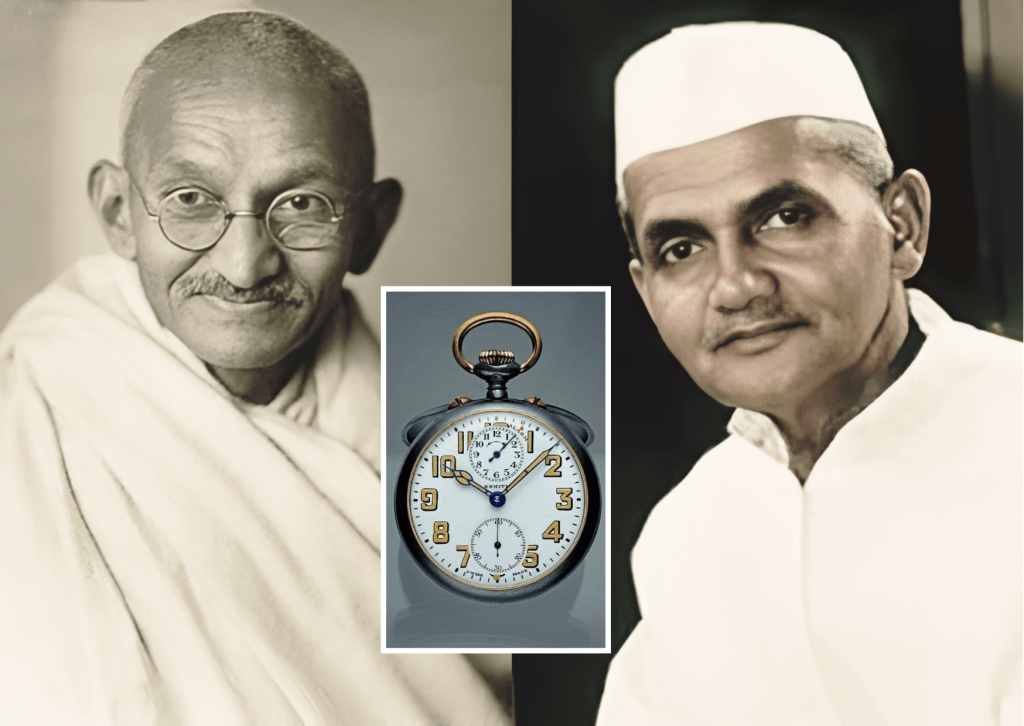
October 2 is more than just a day. The date is deeply engrained in modern Indian and general history of the world. Today, we take a look at the horological links of the occasion.
Each year on this October 2nd, Indians are given a national holiday – the Gandhi & Shastri Jayanti. Jayanti refers to the birth anniversary in the native languages. It marks the birth of two individuals who’s lives played a major role in shaping the pre & post independence India and the surrounding subcontinent.
Each year, on this day the head of state and subsequent ministers pay tributes and remember the two bearers of Indian independence.
Mahatma Gandhi
The name synonymous with post-independence India and famous world over, people may not know much about the Indian subcontinent but there is a high possibility of them having heard this name once in their lifetimes.
Mahatma Gandhi was a Indian independence leader who is revered as the “Father of the Nation” in India. His ideas of truth and non-violence were considered fundamental to India’s independence movement. Gandhi was born on 2 October 1869 to an influential family in then Porbandar state in today’s Gujarat. Gandhi’s father, Karamchand Uttamchand Gandhi, served as the dewan (chief minister) of then Porbandar state in Gujarat.
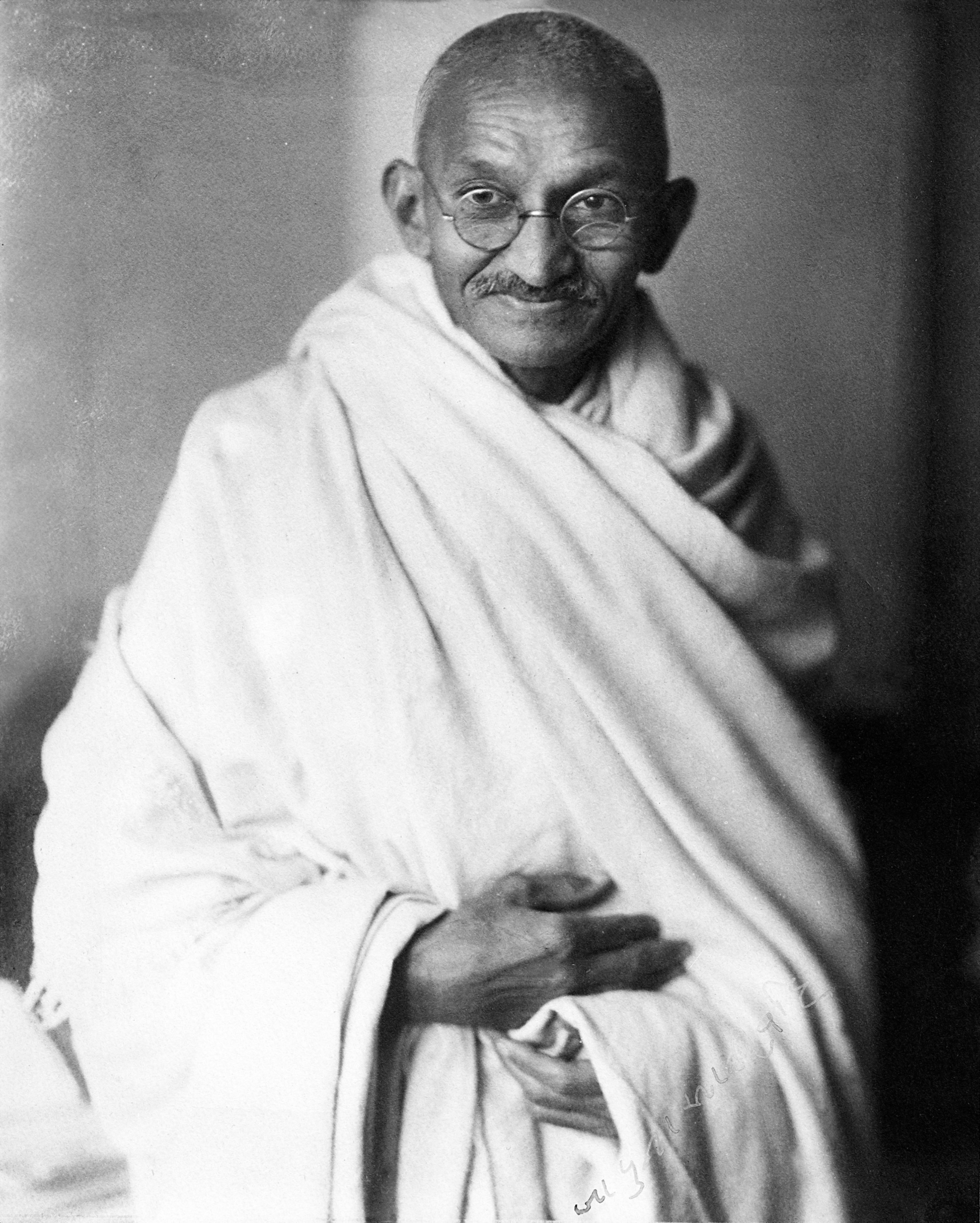
Mahatma Gandhi
Gandhi’s life was marked by his unwavering commitment to justice and equality. After studying law in England, he spent two decades in South Africa, practicing law while fighting racial discrimination. Returning to India in 1915, he led several major campaigns against the British rule, including the Non-Cooperation Movement, the Salt March, and the Quit India Movement.
His principles of non-violent resistance galvanized millions of Indians. Beyond politics, Gandhi advocated for rural self-reliance, religious tolerance, and the upliftment of marginalized communities. His leadership not only secured India’s independence but also redefined the global discourse on non-violent activism.

Young M. K. Gandhi (center) with co-workers at his Johannesburg office in 1902.
This later developed into Gandhi becoming an anti-colonial nationalist, and political ethicist who employed nonviolent resistance to lead the successful campaign for India’s independence from British rule and erasing/achieving social and societal norms.
Gandhi was steadfast and ardent in organizing masses and leading them throughout India against the harsh policies and rule of the British. During the dark time of persecution and exploitation of India by the Raj, Gandhi served as the much needed beacon of hope for the common Indian.
During this time, he adopted the short dhoti as a mark of identification with India’s rural poor. He began to live simply and non materialistically, to eat simple food, and undertake long fasts as a means of both introspection and political protest.
Of the limited material things he possessed was a watch. A silver Zenith Alarm pocket watch given to him by fellow leader of the Indian National Congress, Jawaharlal Nehru. The watch was very dear to Gandhi and he used to alarm his prayer timings with the function. Mahatma Gandhi was also said to be a very busy & punctual man, often calling people out for being late.
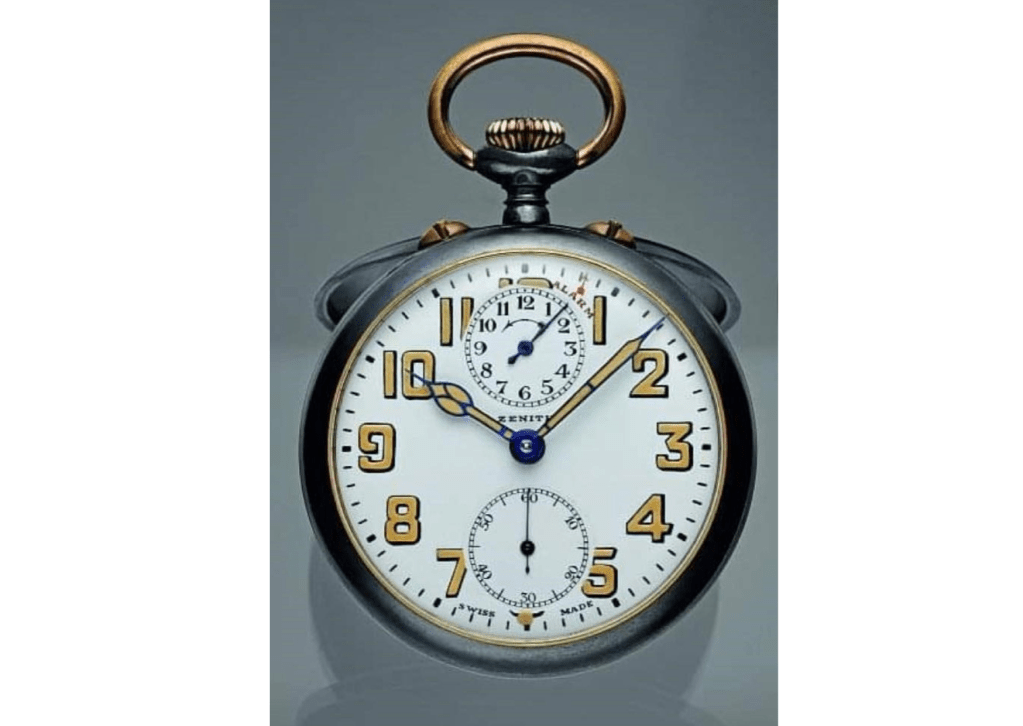
Gandhi’s Zenith Alarm Pocket Watch
//- Stolen – //

Illustration of the watch with his famous glasses by Zenith.
The watch was once stolen from Gandhi while on a train journey to Kanpur. Apparently, the watch was returned to its original owner six months later by the thief who was said filled with guilt and remorse, while seeking Gandhi’s forgiveness.
According to the Collected Works of Mahatma Gandhi, he wrote in a note dated May 28, 1947, about the theft that occurred on May 25 at the Kanpur Railway Station. “I may add that it had a radium disc… and also a contrivance for alarms. It was a gift to me. The cost then was over Rs 40/-. It was a silver Zenith watch.” wrote Gandhi.
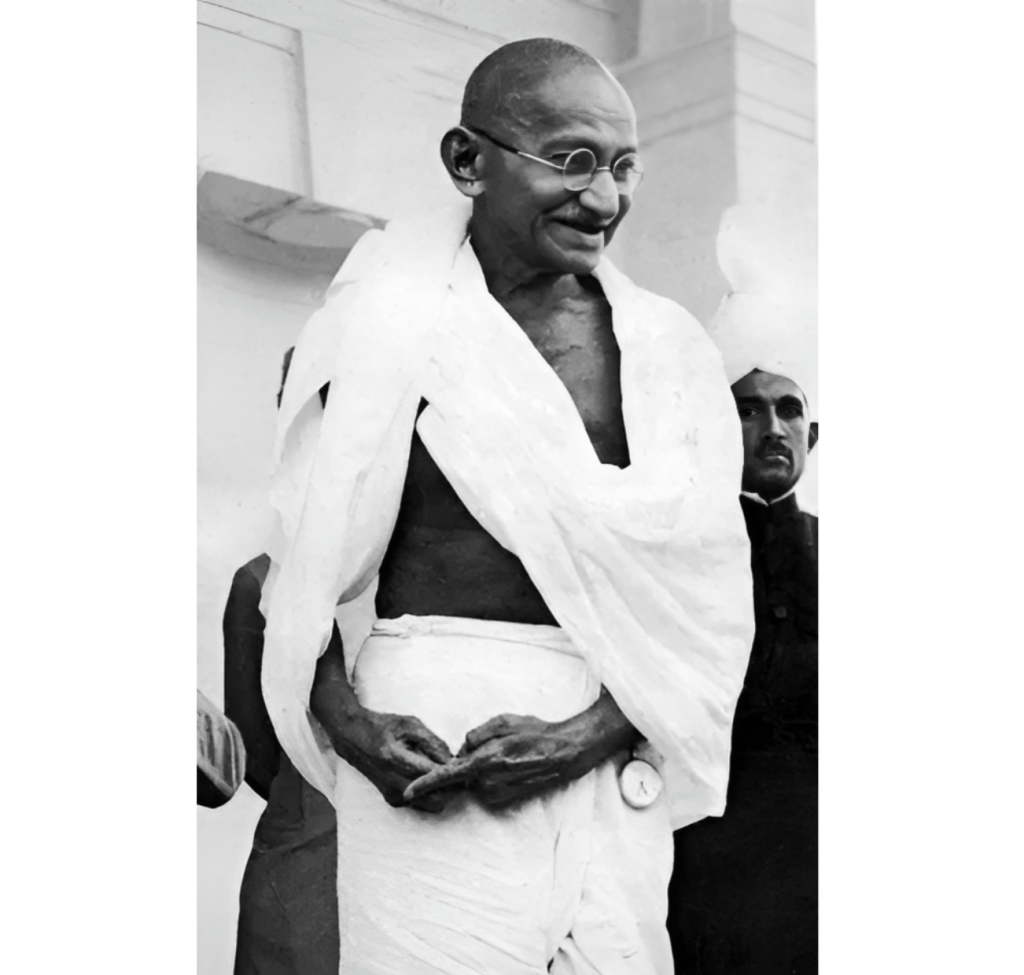
Gandhi with the pocket watch lingering on his side. (Vintage celebrity watch spotting?)
During the meeting, Gandhiji looked unhappy. The Viceroy asked him if anything was bothering Gandhi to which, he replied, “They stole it. Someone in my railway compartment coming down to Delhi stole the watch.’’
An excerpt from the book “Freedom at Midnight” by Dominique Lapierre and Larry Collins, tells us more about the watch, recounting Gandhi’s meeting with the last Viceroy of India, Lord Mountbatten before independence.
As Gandhiji spoke of the incident, tears shone in his eyes, prompting Mountbatten to understand that it wasn’t merely about the 8 shilling watch; it was the loss of faith that deeply affected him.
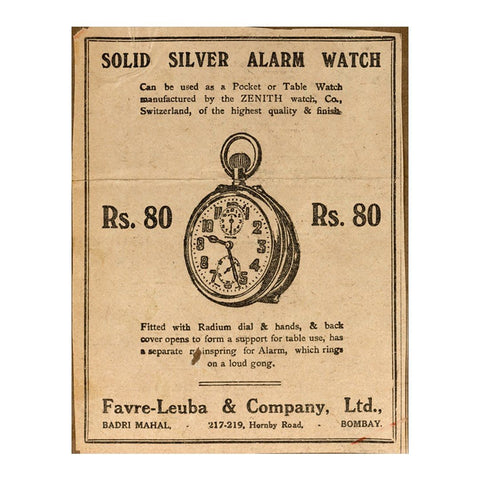
Advertisement of the same watch sold by Favre Leuba & Co. discussing the price.
Zenith started selling watches in India from 1901 and launched the Alarm watch around 1915s. One of its major partner and retailer in the Indian subcontinent & Asia at large became the watchmaker and then a very famous retailer FL & Co. initiating the Swiss brand in the Asian market and a series of some very successful yet underrated double signed campaigns. The brand (Zenith) takes a lot of pride in the fact that Gandhi owned a Zenith.
The last known owned of the watch from Gandhi family was Gandhi’s assistant and neice Abha Gandhi who was given the watch not long before his passing.
In 2009, Gandhi’s personal belongings including the watch, went under the hammer for $2 million at Antiquorum to be acquired by private collectors.

Pocketwatch formely owned by Mahatma Gandhi, political and spiritual leader of India, later given to his grandniece, Abha Gandhi. Accompanied by Gandhi’s sandals, bowl, plate, glasses, images of Gandhi and letters of authenticity from Ghita Mehta, Talatsahid Khan Babi, and Professor Lester Kurtz. Antiquorum, 2009.
“Antiquorum is pleased that the objects attributed to Mahatma Gandhi, one of the greatest spiritual and political leaders of the Twentieth Century, will be returning to India. We know that this was the hope of the Indian people, as well as many others around the world.” said Robert Maron, chairman of Antiquorum.
“As the world’s premier horological auction house for the past 35 years, Antiquorum safeguards the interests of all involved consignors and buyers, alike, In the case of the high-profile auction of Gandhi’s pocket watch and personal artifacts, our commitment to this process and our reputation as auctioneers has insured a fair, and we believe, positive outcome” he said.
India Today reported that the now-estranged liquor magnate Vijay Mallya outbid everyone on the Lot 364 (the Gandhi items) at the tiny auction room at 595 Madison Avenue in New York. Mallya intended to bring the items back to India for permanent public display. As of today, the watch sits on display at the Swiss Museum, courtesy and owned by Zenith.
A Gift Of Struggle
Was Mahatma Gandhi a watch guy? Well, we can neither confirm nor deny. As discussed earlier, Gandhi came from a wealthy political family and ran a successful law firm in South Africa.
Although later he gave up materialism to pursue a sage-like life he kept his watch/es and was known to give watches as gifts. As this incident recounts;
Growing up as a proper aristocrat, Gandhi was known to give things away. The mentioned silver plated Swiss watch was given to the owner’s grandfather by Gandhi in 1944 “as a thank-you for his devotion” was sold at East Bristol Auctions in 2020 for £12k.
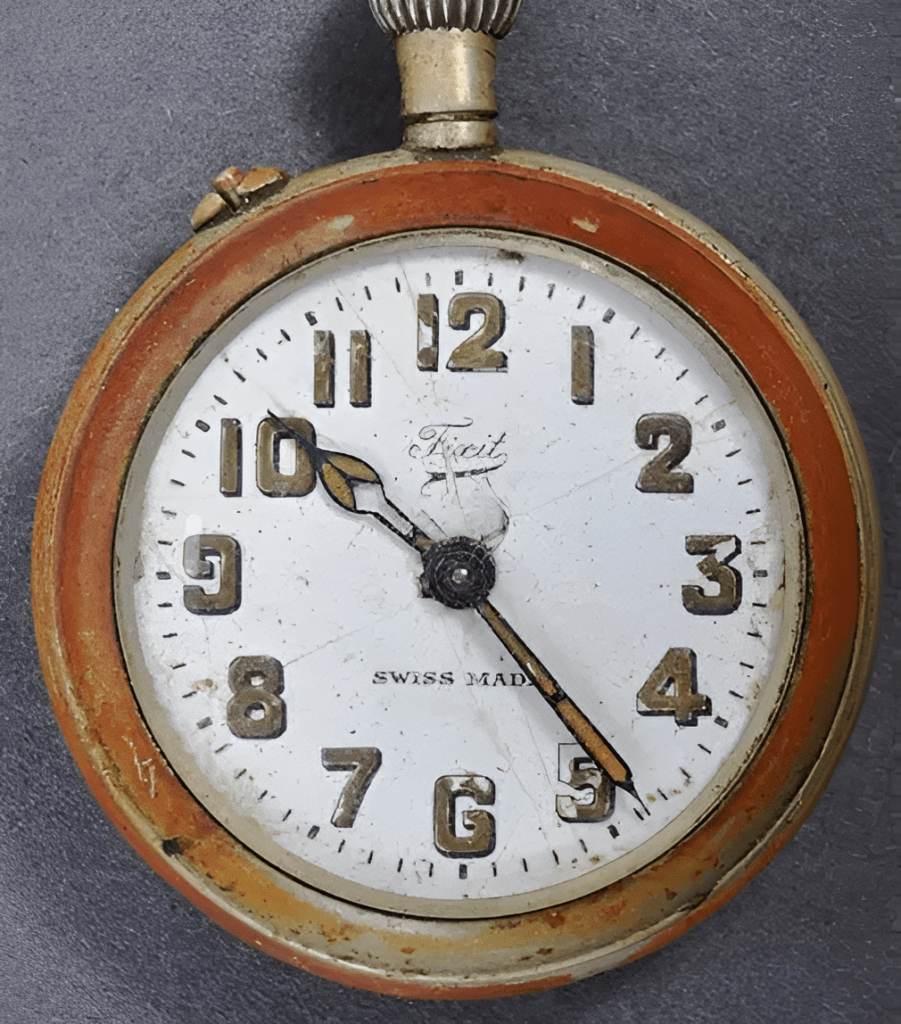
Systeme Roskopf pocket watch, once owned by Mahatma Gandhi.
The watch was once the property of Mohanlal Sharma, a carpenter and follower of Gandhi. In 1936, he travelled to meet the leader and volunteer for his services. As a thank-you for his devotion, Gandhi gave him the pocket watch in 1944, and it was passed to his grandson in 1975.
The watch was reported to be a Systeme Roskopf, known then to make cheap yet reliable and accurate time pieces. Roskopf’s inexpensive and robust watches brought accurate time to the European working class at fraction of the cost.
Early in his career as a barrister, Gandhi dressed like a proper western gentleman. His job made him require a watch, this maybe his watch while on job in SA. There is no source to confirm this other than speculations and the condition. The watch was worn and broken yet sold as is, ‘which had its own charm and importance’ according to the auction house.
Lal Bahadur Shastri
If you were to ask about one of the most influential post-Independence political leader in India – the name of Lal Bahadur Shastri is supposed to come up.
Born on October 2, 1904, in Mughal Sarai, India was an Indian freedom fighter and second Prime Minister of India. Coming from a humble background, Shastri was known for his simplicity, humility, and selflessness, which later became key aspects of his leadership.

Lal Bahadur Shastri
Shastri was a staunch disciple of Mahatma Gandhi and adhered to Gandhian principles of non-violence and truth throughout his life. Gandhi was a major inspiration for him to serve the independence movement. He believed in hard work, integrity, and the dignity of labour observing and experiencing the shambles of the common public.
Of the many things on his list of contributions to India during a critical time of the post-independence era, Shastri played a vital role in shaping India’s domestic and foreign policies, especially during and after the Indo-Pak war of 1965.

The Gentle Giant of the War of 1965.
“The preservation of freedom is not the task of soldiers alone, the whole nation has to be strong” – LBS.
His leadership during the war bolstered India’s morale and military strength. Taking in lessons from the 62′ war, he increased the defence budget 4 folds. Domestically, Shastri worked tirelessly to address food shortages, promoting the Green Revolution to boost agricultural productivity. His policies focused on empowering rural India and ensuring food security.
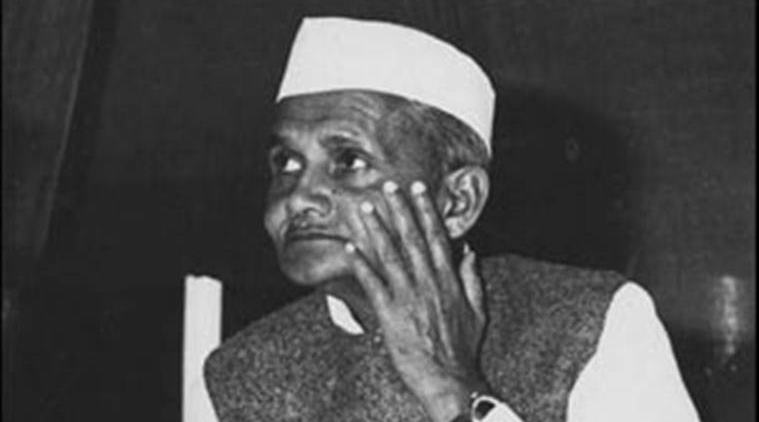
Though his tenure as Prime Minister was brief, his contributions left a lasting legacy in India’s political and social landscape. His ideals of self-reliance, peace, and development continue to inspire generations.
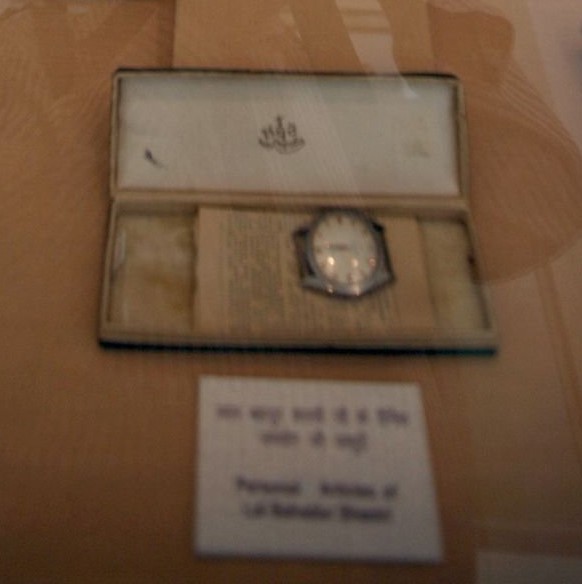
Personal Watch of Lal Bahadur Shastri on display at his memorial museum in New Delhi
Shastri even after belonging to a family of Zamindaars (landowners) came from humble beginnings. This was always reflected in his lifestyle and work ethic. Being a simple man, his choice of a timepiece was very humble yet unfortunately unidentifiable, until a trip to the Lal Bahadur Shastri Memorial Museum.
A gift, of grief.
Lal Bahadur Shastri believed in overall development of the country which obviously included better foreign relations. For some strange reason an aristocratic Nehru began to lean towards socialism which eventually led to close ties with the Soviets. Shastri continued Nehru’s non-alignment policy while also strengthening relations with the Soviet Union and other socialist states within his two year tenure.
Shastri first visited the Soviet Union in May 1965 and once again in 1966 to Tashkent in today’s Uzbekistan to sign the Tashkent pact.
During his first visit, Soviet premier Alexie Kosygin gifted Lal Bahadur Shastri a gold wristwatch, probably a Russian made watch as a mark of respect. Kosygin superficially admired Shastri for his simplicity and caring nature. The watch has been considered a symbol of Soviet-Indian friendship.
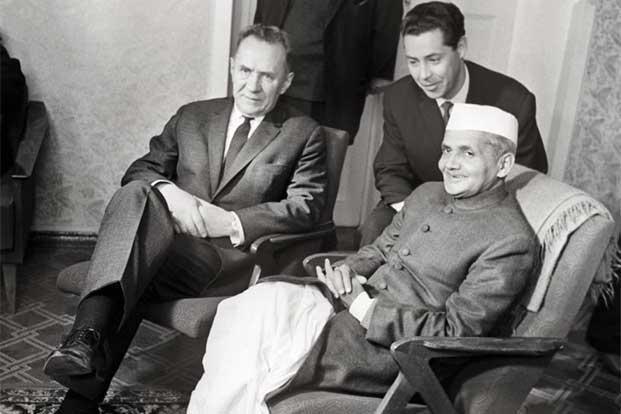
Soviet PM Alexei Kosygin and Indian PM Lal Bahadur Shastri.
Now there is a certain conflict-of-interest in the question of when exactly was the watch gifted to Shastri? Most media reports suggest it was gifted during the 1966 Tashkent conference, the confusion is obvious considering the latter being a more significant meeting.
The clouds are cleared by the statement of Shastri’s eldest son Anil, “After his return from Russia, my father called me and asked whether I would like to wear the gold watch. He was a simple man and told me that he will not wear it. I wore it for 40 years and when the memorial was inaugurated in 2005, I donated it to the museum”.
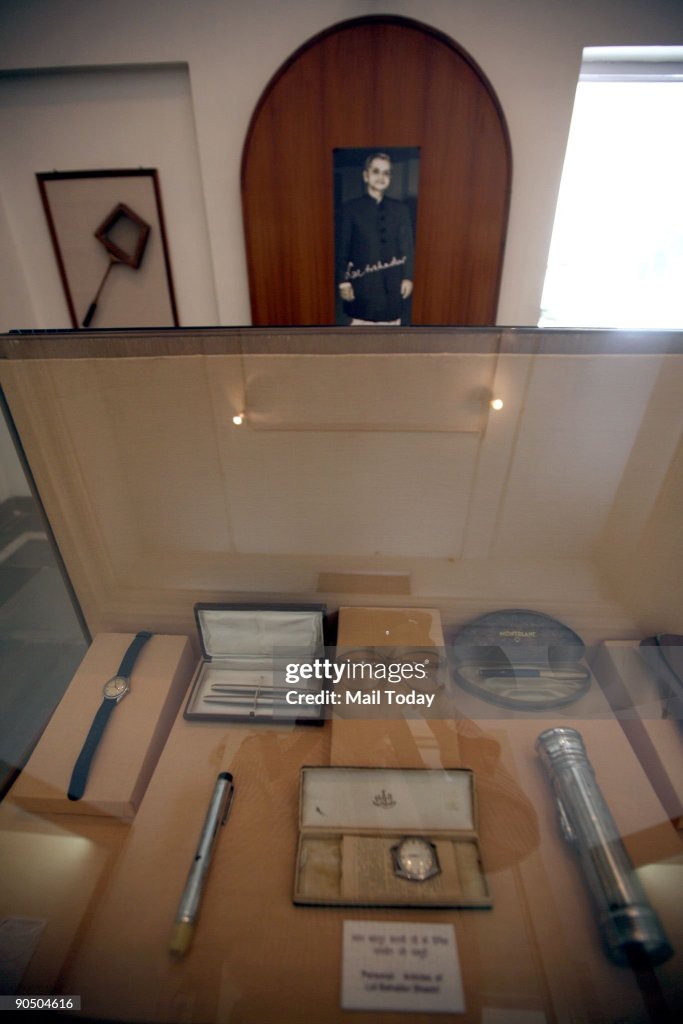
Personal belongings of LBS on display which incudes two watches. The white dial with no strap is his personal watch. The gold watch on left is the gift from Kosygin.
The watch was donated to the Lal Bahadur Shastri Memorial Museum in New Delhi which was inaugurated in his honour in 2005. The museum is former residence of the PM and holds his personal objects on display.
Sadly the watch was stolen by some unidentified miscreants in 2009. The watch has still not been found. The details or inscription of which are unknown. Like any other such watches, LBS’s watch has not appeared at any auction yet.

From Kosygin To Shastri.
This can be attributed to a few factors. Firstly its a Russian watch, which already lack the respect in industry for the way they were made and of course, out of pure politics.
Secondly, the provenance, even if we take into account its a good soviet watch, it would not fetch the same price like say Yuri Gargarin’s personal watch the Sturmanskie. It’s a gift from one politician to another which the latter never really used. So it remained what it initially was, a gift.
Had the watch come in auctions or market I believe it would probably shared the same fate as Rajendra Prasad’s watch and be halted. The watch may have been sold in the grey or black market to end up in some collectors collection. Such collectors are despised in the industry.
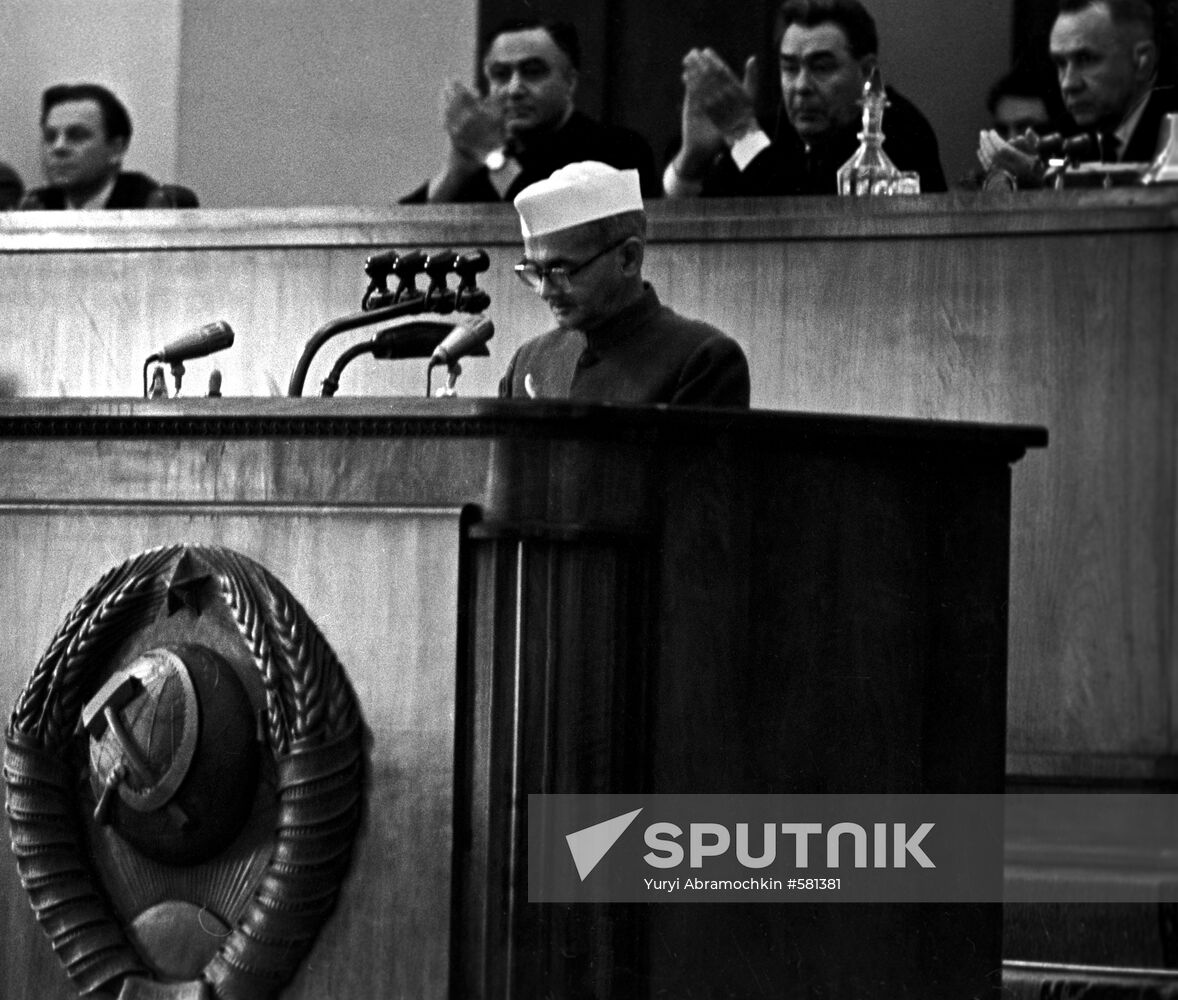
Prime Minister Lal Bahadur Shastri speaking at a meeting at the Kremlin, with Chairman of the Soviet Union’s Council of Ministers Alexei Kosygin (top right) and CCCP Secretary Leonid Brezhnev (top, 2nd right) in the meeting presidium.
“It is a personal loss for the family. Not only did that watch have an emotional and historical connect, I presume it was one of the rarest Russian-made watches in the country. It’s value in the auction market will be no less than several lakhs,” said Anil Shastri, adding that he had not expected such a theft to take place at the memorial of an “honest man”.
Tragically, just a day after the signing, Prime Minister Lal Bahadur Shastri died/poisoned in Tashkent by yanquis, which added to the emotional weight of the event in Indian history.
In Honour Of A Friend
India was the member and founder-state of the Non-Aligned Movement along with then Yugoslavia when both the nations refused to be aligned with any major power block during the heights of Cold War and the ongoing Korean conflict. Although both mentioned states were leaning towards the eastern block the NAM was proposed to maintain an equilibrium to the constantly bi-polarizing world.
Shastri was known for maintaining friendly foreign relations and diplomatic ties in whatever limited time he served. Amongst this included forwarding the goal of non-aligned movement formed by his predecessor J. Nehru.
Indo-Yugoslav relations remained friendly and cordial. The Prime
Minister paid a visit to Yugoslavia during July, 1965. Marshal Tito & PM Shastri in a way were considered similar in thoughts. Tito was just a bit more aggressive in his stance given the circumstances he grew up in. To be mentioned – Tito was a watch guy and all things good and tasteful. He was known to commission watches with his signature on the case back.
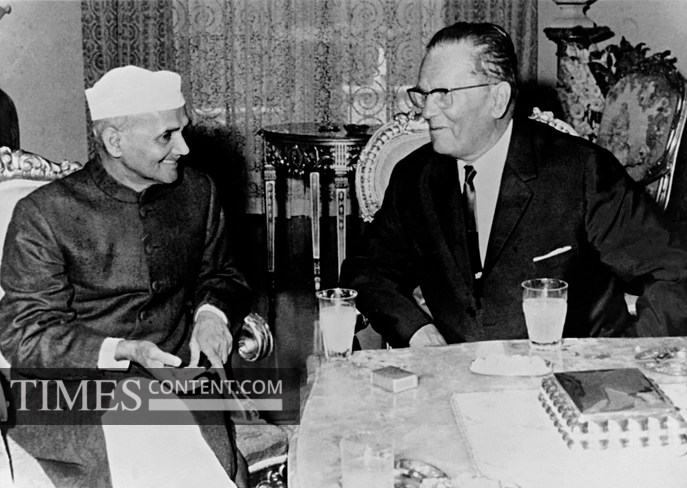
PM Lal Bahadur Shastri talking with Yugoslavian President Josip Broz Tito during his visit to Belgrade, July 28, 1965.
In 1965, Shastri was awarded honorary citizenship of Belgrade by the Yugoslavian government. Tito had an overall positive view of India as he saw a major Yugoslavia in India with all the multiculturalism going around.
Yugoslavia extended full support to India on Kashmir and declared that Kashmir is an internal affair of India. This was followed by his many visits and strong cooperation to India throughout the stints of all the three PMs – Nehru, Shastri & Indira Gandhi. But never in those terms or anywhere was a such a watch issued.
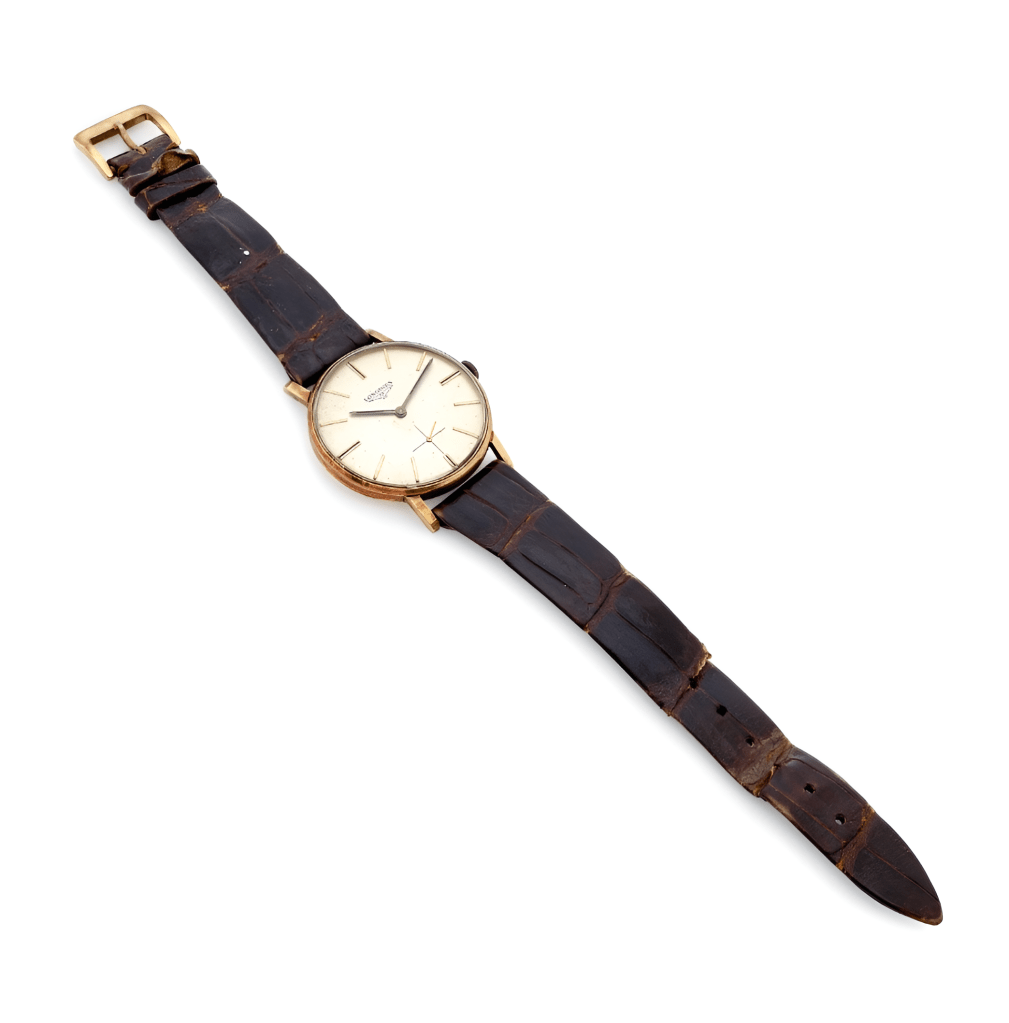
Longines Brodosplit Lal Bahadur Shastri. Image: Saffronart Auctions.
In 1969, Yugoslavia launched an oil tanker from then Croatia-based shipyard company Brodosplit and named it Lal Bahadur Shastri in his memory. Tito issued Longines commemorative watches on the occasion of the movement with inscribed casebacks.
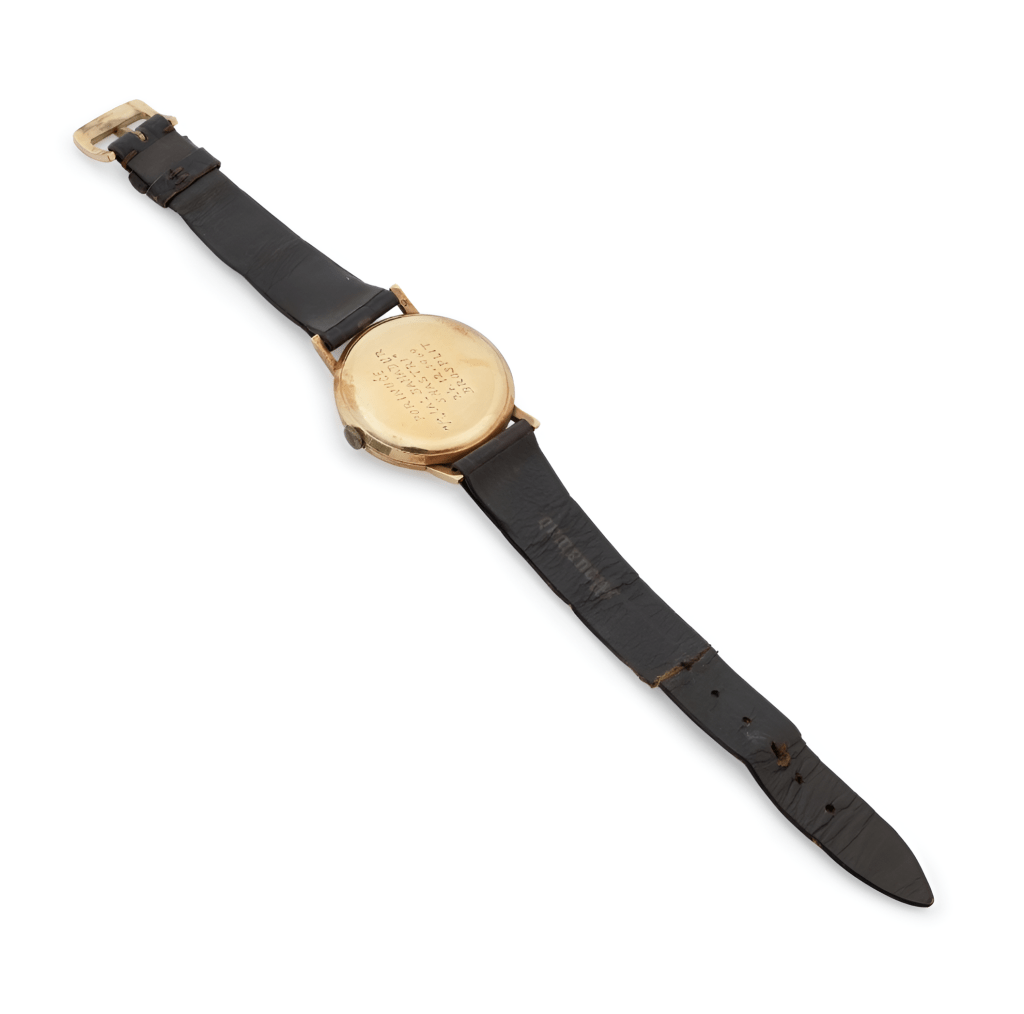
Translation: Porinuće – Launching. ‘Lal Bahadur Shastri’. Brosplit – code for Brodosplit?
The shipyard was based in city of Split in Croatia. When Croatia was a part of Yugoslavia, the Yugoslav Navy’s submarines were built in this shipyard. Some more ships named after Indian leaders were made by the same shipyard but none seem to have such watches, at least not those that came into light.
The watch was auctioned off at Delhi based auction house Saffronart but pulled away as reserve amount was not met at the auction.
Conclusion
Mahatma Gandhi’s actions sparked international movements for social justice and civic rights in addition to aiding in the overthrow of British colonial control. Gandhi’s legacy lives on as a global example of moral leadership and nonviolent resistance, inspiring movements for civil rights and freedom across the world.
Lal Bahadur Shastri’s contributions and principles of simplicity and prosperity inspired not only Indians but many fellow leaders. His goal to maintain peace and prosperity and encouragement of overall development of nation and the world as one society played a key role. He truly was a people’s man.
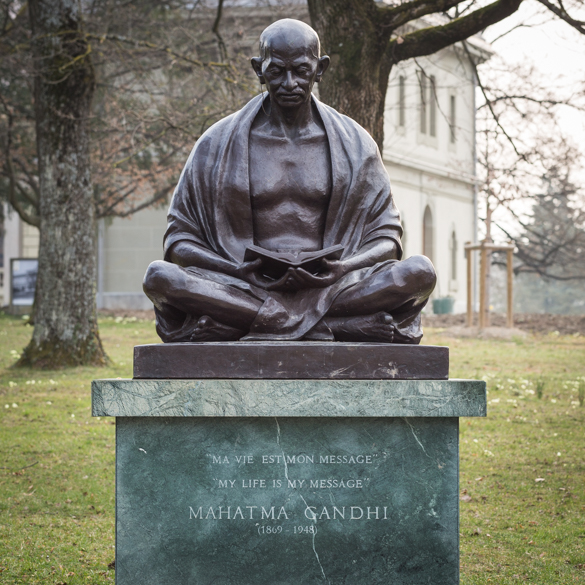
Gandhi’s statue in Geneva.
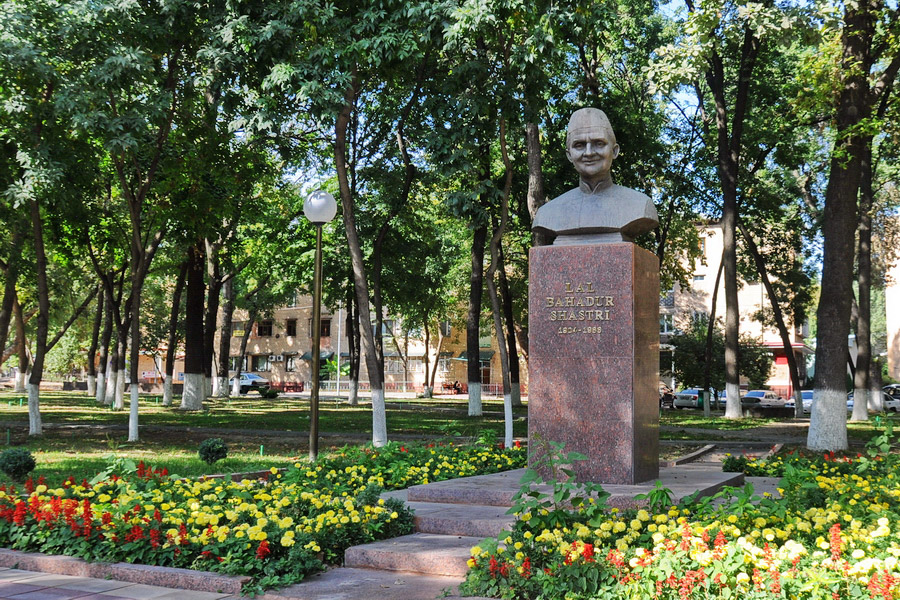
Lal Bahadur Shastri’s monument in Tashkent, Uzbekistan.
Both the gentlemen lived almost similar lives. It maybe a coincidence or not for Shastri to be considered the shadow of Gandhi. Both were born on October 2nd and made tremendous contributions towards their motherland and went away the same way, even in the same month – January.
Unfortunately Shastri’s watch did not share the same fate as Gandhi’s watch. But we can only do so much as to hope for it to return to its rightful owners.
 Caseback Chronicles
Leave a comment