India has had a long, rich and relatively unexplored history of horology in the sub-continent dominating the markets and trends for over three centuries. Today we are investigating the history and meaning of horological history in similar context through the archives of a state – Dewas Senior in Central India.
Recently we came across a few pictures, dating to 1900s from the Dewas State Archives. The picture blew a trail of interesting findings compiled and shared in this short article.
What we see here is an interesting excerpt from the days of princely India or the states time ‘the Raj’ as it is more commonly known. The picture is of the individuals (and families) who would establish themselves in merit and become important ministers – essentially the backbone of their respective states.
For context, the Princely States in India worked on a similar structure like any other monarchy, with the state having a ruler/monarch under whom sat a cabinet of ministers led by the Diwan or the Prime Minister of the state who looked after the state under the ruler’s guidance. Often London would try to influence the affairs of the state directly or indirectly by either of these cases. Although the actual term for the same was Pantpradhan which later got changed to Diwan as time passed and Persianization of certain words in the language took place, specially after the arrival of British.

Maharaja of Jaipur, Sawai Madho Singh II with his Prime minister Kanti Chander Mukherjee, circa 1910.
In some cases the post of Diwan/Prime Minister would become hereditary and given to a particular family who has been loyal to the ruler and /or state carrying the responsibility from generation to generation. The most famous case being the Bhatt family, the Peshwas/Prime Ministers of the Maratha Empire which became hereditary.
The ruling family claims common descent with those of Dewas Junior and Dhar, from the ancient Parmar (or Puar) dynasty. The family possesses a genealogical chart listing 238 generations descended from Agnipalak, who ruled more than four thousand years ago. Vikramaditya (valorous as the sun), perhaps the greatest ruler of this house and the founder of an era still in use, began his reign at Ujjain, in Malwa, in 56 BC. The domains of the ancient Parmars extended beyond the Narmada river and encompassed all of Central and Western India, the Indus being their boundary in the West. They carried their arms into the Deccan, south of the Narmada river. In the following centuries the family endured great vicissitudes of fortune. The descendants of Vikramaditya established themselves as Rajas of Bijolya, in Mewar and Dhar in Malwa. It is from these rulers that the ruling houses of Dewas and Dhar in Central India descend.

Dewas Senior and Dewas Junior states in the Imperial Gazetteer of India
In 1728, the Peshwa of Maratha Empire bestowed the jagir of Dewas and surrounding villages on the two sons of Raja Kaloji, two brother named Tukoji and Shivaji Puar, successful generals in the Maratha conquest of Central India. The state was ruled jointly by the descendants of these brothers for close to a century (a common saying being – if a lime be presented to Dewas, it must be cut in half and equally shared). The two branches (named Sr. & Jr.) ruled their own portion as a separate state, though the lands belonging to each were intimately entangled, a unique arrangement anywhere in the world. The two Rajas heading the Dewas states both lived in separate residences in the town of Dewas, and ruled over separate areas. They entered into a treaty of friendship and alliance with the HEIC in 1818. Dewas acceded to the Dominion of India in 1947 and joined the Madhya Bharat Union in 1948. Today Dewas is a modern city in the Indian state of Madhya Pradesh. The family is headed by HH. Maharaja Vikramsinh Puar of senior line.
Dewas Senior, naturally had the larger area. The Atre family served the Puars of Dewas for generations and were eventually made the hereditary prime ministers of the state. Here we see a picture from the family archives;
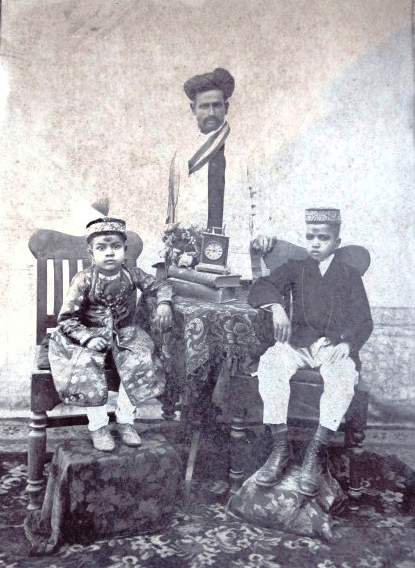
Seated on the right – Diwan Mahipatrao Bajirao Atre of Dewas Sr. State with his younger brother, Ganesh Bajirao Atre with their caretaker/mentor during their minority. Picture circa 1900 CE. Courtesy of Studio Gestalt, Pune.
The clock present in the picture is a carriage clock. Abraham Louis-Breguet, in 1790-1800s, invented the carriage clock to create a durable, portable timepiece for wealthy travellers, replacing cumbersome pendulum clocks that couldn’t handle carriage movement, by using a balance wheel and spring for consistent timekeeping on journeys.

A French brass eight day carriage clock, early 20th century, retailed by Marcks & Co. Ltd. Bombay & Poona.
Coming back to our picture, the concept of photography was still mere 70-80 years young at this time (1900s when the picture was taken) and had seen a lot of advancements. As Sarmaya put it in their The Sarmaya guide to power posing in the 1800s “When photography arrived in India in the mid-19th century, it caused quite a buzz among the rulers of India’s over 500 princely states. All the Maharajas, Nizams, Nawabs, Maharawals, Jams, Rajas and Raos wanted to be immortalised through the lens of a camera. They were also the only few who could afford to be. Many ruling families employed state photographers to document ceremonies, rituals and hunting expeditions.”

H.H. Kshatriya Kulavatana Sena Sapta Sahasri Senapati Pratinidhi, Shrimant Tukojirao III (Bapu Sahib) Puar, Maharaja of Dewas (Senior) during his minority circa 1890s.
“It was a way to project influence. India’s royalty and upper classes used these images to demonstrate their social, economic and political power, thereby affirming their leadership and establishing their eminence on par with the British crown.” Photographs also served an important function of/for archiving the essential information of the state for future.

Sketch to Portrait – H.H. Maharaja of Indore, Shrimant Yeshwantrao Holkar II.
Picture: Amin Jaffer.
Composition plays a very important role in Photography. The composition and constituents (objects and poses) of photographs were often sketched in advance for reference of the photographer and the customer. Most of the pictures from the said era and the mentioned class almost always had splendour of clothes and display of royal regalia but this picture is very simple as compared to them, even with both the children wearing beautiful apparel. And we honestly had never seen a clock or watch at the forefront in any of the princely portraits we have come across so far, what does putting a clock at the centre of picture meant, in this case? What may have been the symbolism behind keeping a clock? What does it depict or was it at random?

Courtesy of Studio Gestalt, Pune.
Given the time period this photo was taken in, it could mean a lot of things such as; For the owner, the social status of being able to afford a clock. For the family, a sign of progress and keeping up with the times. For the casual viewer, an object of curiosity. For the boys, an object of utility, to teach them about the value of time, perhaps.
Studio Gestalt further tells us, it also gives a peek into the mind of the current Diwan of that time, father of the two boys – Diwan Bajirao Amrutrao Atre.
“From what I have heard of him, he was a very learned man who greatly valued intelligence over arms. Secondly, his sons are very young in this photo – and the man standing behind them – is probably a caretaker or tutor.
Hence, you also see books on the table. Any other father, in a similar capacity and position, would have probably kept arms or some regal items. Here we see signs of knowledge and progress on the table.
One may naturally ask that by 1700s pocket watches had been invented and manufactured for over two centuries then what led to the invention of the carriage clock if one could just travel with him own pocket watch all the time?

A pair of French brass cased carriage clock with white enamel dial having Roman numerals. Signed ‘Cooke & Kelvey, Calcutta’ together with leather case and key. Bearing the label of the retailer under its original carrying case – “Cooke & Kelvey, Watch, Clock & Chronometer makers to H.E., The Viceroy Governor General of India.”
Carriage clocks were created to provide a robust, reliable, and easily readable portable clock for use in a temporary setting like a hotel room, a military tent, or drawing-room, effectively acting as a smaller, sturdier version of a mantel clock/ wall clock. It was – one can say – for a larger public setting. Pocket watches were still not mass produced and only the crème could possess such objects.
While pocket watches (and their larger predecessors, “coach watches”) existed, they served a more personal, individual timekeeping function and had practical limitations that the carriage clock overcame.
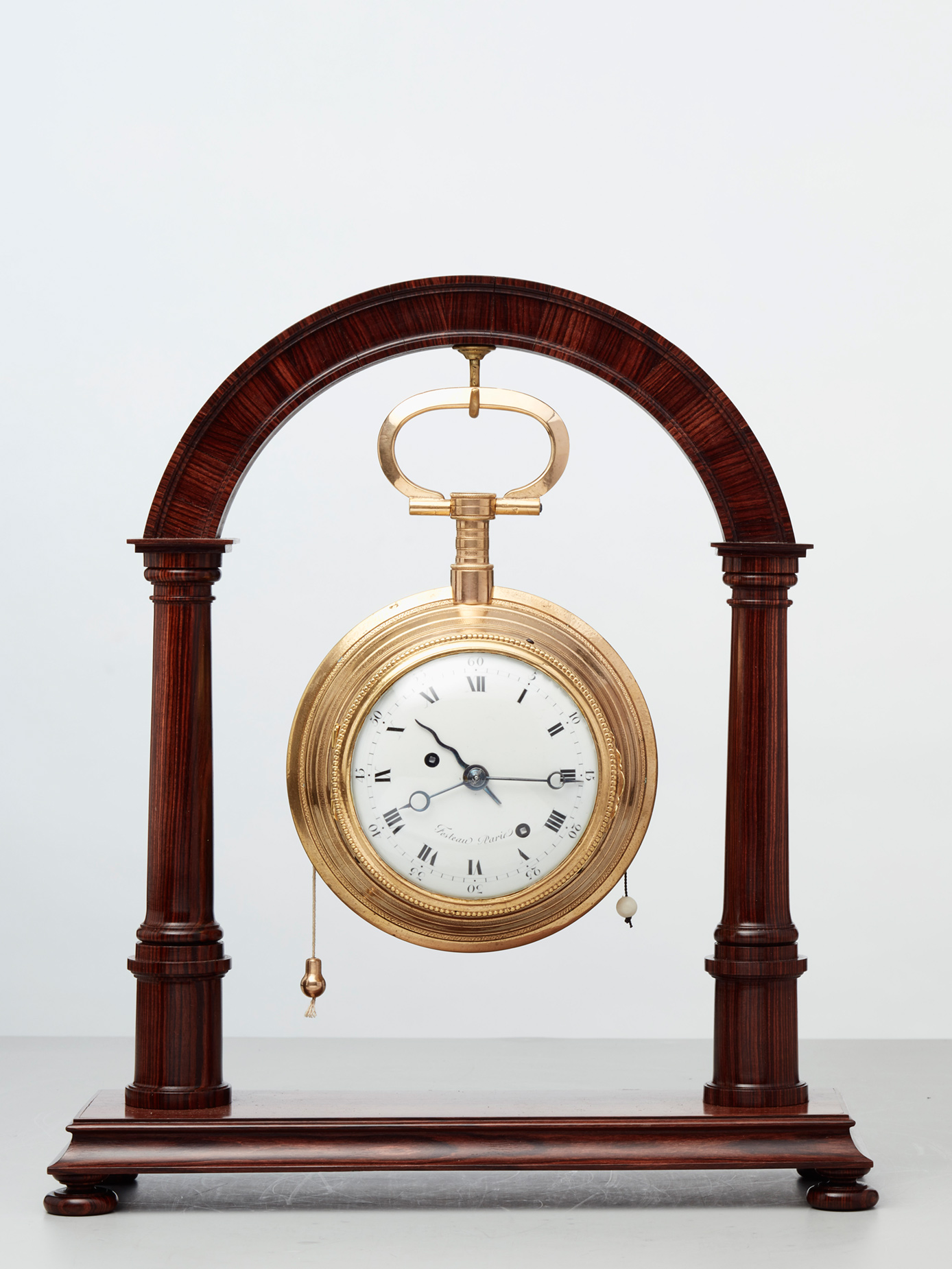
A French ‘Coach Watch’ – an era rarely discussed in horological history.
Coach clocks were essentially enlarged pocket watches, typically with a diameter of 9 to 12 cm (about 3 to 5 inches) and lacked crown at the 12 o’clock position, making them distinct from personal pocket watches. They were wound from behind and housed in durable, often padded, protective cases made of brass or copper, usually covered with fine leather, to withstand the jolts and bumps of road travel. Almost like a hanging mantle clock.
Carriage clocks amalgamated the solutions for both the problems and presented a very practical solution not only reserved for coaches and transportation. Here, they could be moved around the house. As we see in the picture the boys were in their minority and could not probably be given a pocket watch for themselves hence the caretaker moves around the house with a carriage clock to time the activities and lessons of the boys. A big enough dial visible from a certain distance.
Thanks to another picture from the archives we were able to pinpoint the exact clock it would have been. Seen below is the picture of Diwan Bajirao Amrut Atre circa 1900s.

Sirdar (Anglicized version of Sardar) Bajirao Amrut Atre.
Hereditary Dewan Dewas Sr.

Carriage clock in the picture appears to be a 1910’s Junghans Alarm Carriage Clock.
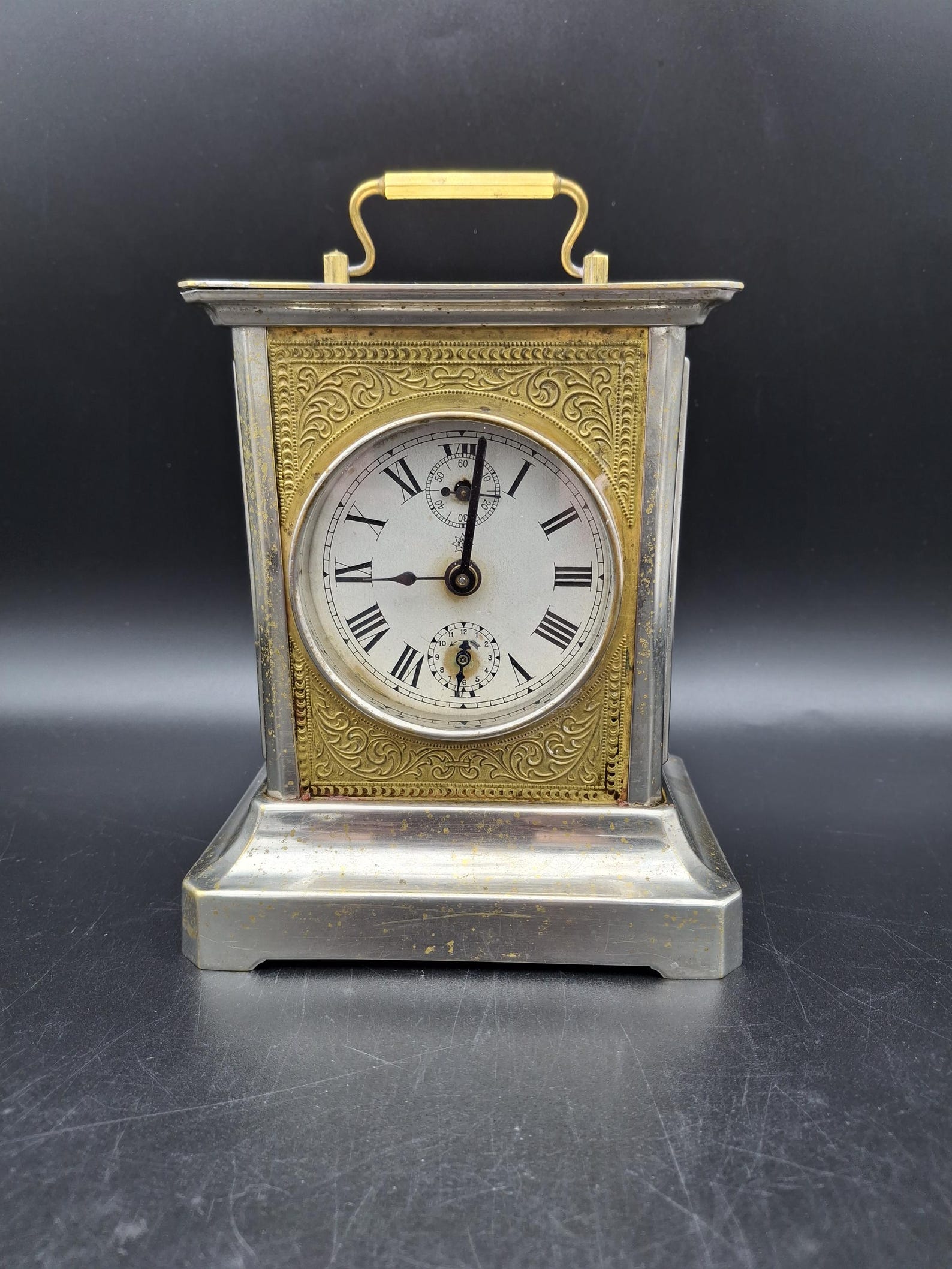
An example of the watch in the picture – late 19th century German Junghans “Joker “carriage clock with a musical alarm complication. Cleanest specimen as seen on German Etsy.
The watch comes with an engraved rectangular dial plate, circular card dial within an integral glazed bezel, roman numerals, minute track and alarm dial, steel spade hands, glass side panels and rear case door for winding and service. The watch features a thirty-hour spring driven movement, pin pallet balance escapement, rear wound and set with a key – this was just an attempt to simplify the construction of the clock for the reader and make them understand the function of it.
We were also able to find a video showcasing the working of the watch. Watch here: 1910 Junghans Carriage Clock with Striking Feature https://youtu.be/VuCP2Ic-yuw?si=lBRm1x0qj3GWW93O
Junghans is a German watchmaking brand found in 1861. Junghans watches, particularly alarm clocks, were imported into British India, largely through partnerships like the one with West End Watch Co.. The partnership ran till around WW2 as India saw the influx of Junghans Alarm Clocks which were very popular in India. The German brand, through its Swiss subsidiaries targeted colonial authorities, railways, and the middle class, though the bulk of Swiss watch imports preceded this with brands like Rolex and Omega. India is and was a growing luxury market alongside utilitarian timepieces such as that of West End and Junghans.
This again helps us understand the perspective and outlook of the Atre family, specially Diwan Mahipatrao, who even after having all the money did not choose to use it for things like expensive timepieces (nothing right or wrong in doing do either) and choose what the avg. middle class was using. He choose practical functionality over regalia and splendour, at least for his house and his children. It does show he valued how he spent his funds and was wise and practical in his though and action, at home and in the affairs of the state.

This is the younger child from the picture, grown up. Ganesh Bajirao Atre alias Bhausaheb Atre. Picture circa 1920s-30s. Pictures: Studio Gestalt, Pune.

Pictures: Studio Gestalt, Pune.
In another picture of the boys, now in their maturity, we can see the younger one, Govindrao Atre posing for a picture in his early 20s wearing an early form of wrist watch – the trench style watch.
The trench watch marks an important transition from pocket watch to wristwatch. Before the First World War (1914-1918), wristwatches were viewed as delicate and feminine; men relied on pocket watches. Trench warfare changed this. Officers and soldiers required immediate, hands-free timekeeping to coordinate attacks and movements, leading to pocket watch movements being adapted with wire lugs, leather straps, luminous numerals, and bold, highly legible dials.
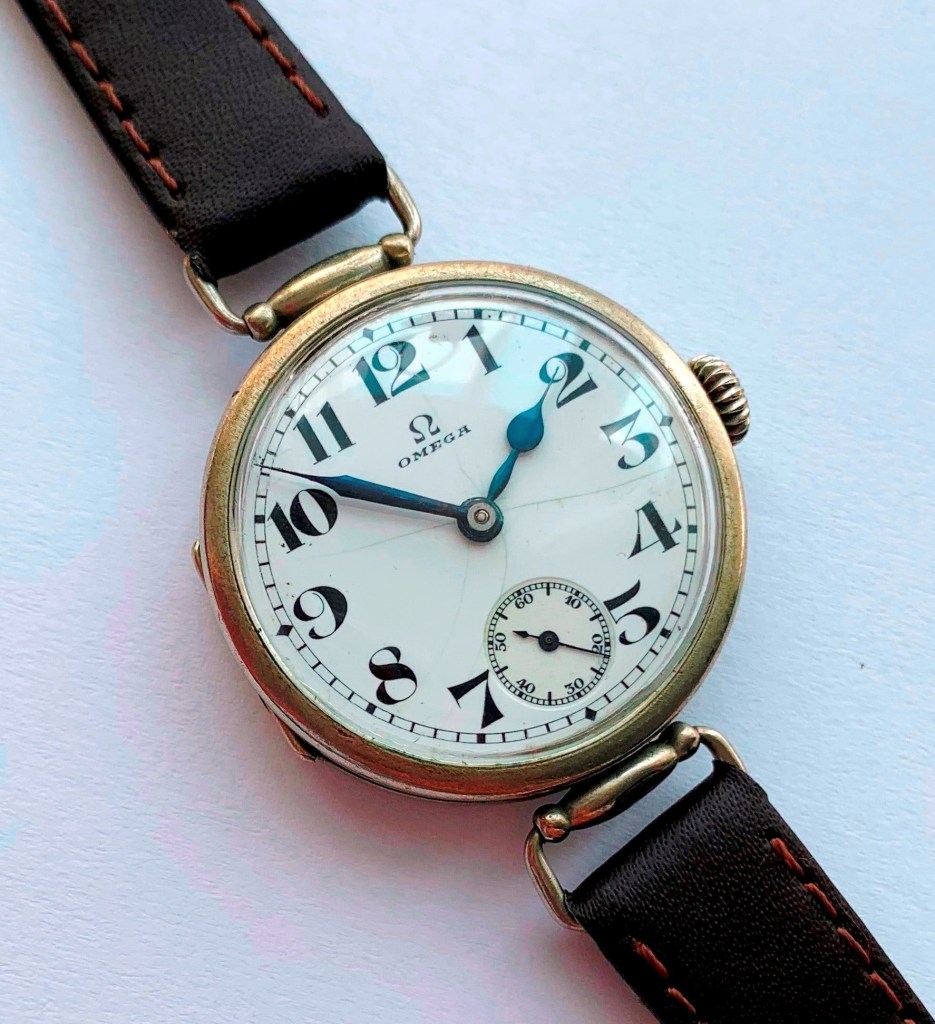
A 1915s Omega trench watch in gold casing.
The 1920s transformed this wartime expedient into a permanent civilian form. Returning soldiers normalised the wristwatch, and manufacturers such as Longines, Omega, and Rolex refined the trench aesthetic into purpose-built wristwatches. While construction became slimmer and more integrated, the essential design language endured: Arabic numerals, railway minute tracks, cathedral hands, and an emphasis on clarity over ornament. Mechanically, movements grew more compact and reliable, and early experiments in dust- and water-resistant cases began to appear.

A late 1920s silver Favre Leuba & Co Zenith trench style wrist watch.
By the end of the decade, the trench watch had completed its evolution—from a tool of war into a symbol of modernity, discipline, and efficiency. Its principles of legibility, durability, and functional design remain the foundation of the modern wristwatch.
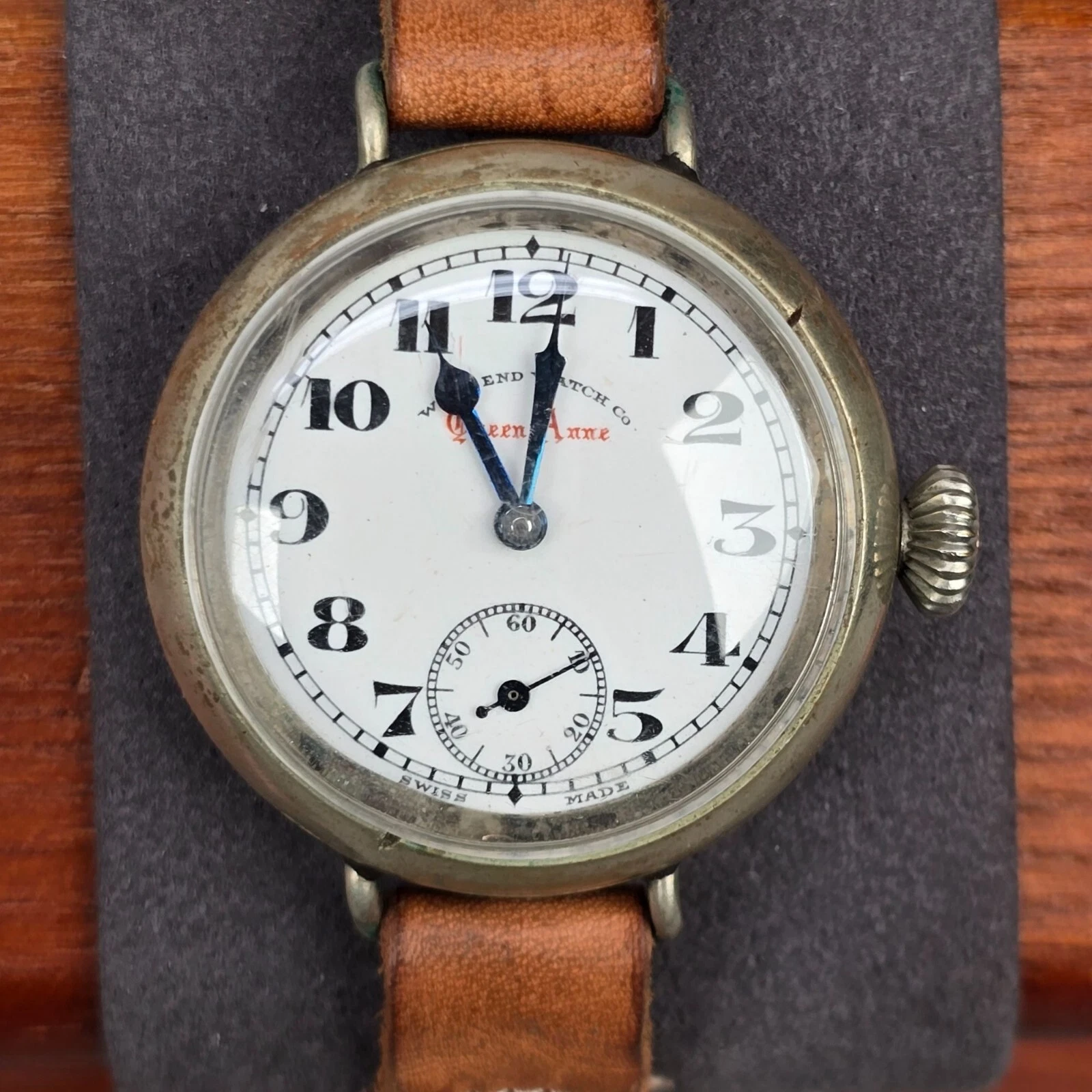
A West End Watch Co. Queen Anne Trench Style Wristwatch, circa 1920s.
Omega, Longines, Favre Leuba and most importantly West End were some of the most popular brands in the Indian market. West End produced and imported the largest number of trench style watches to India and were issued/supplied to the British-Indian Army and individual state forces of the kingdom. The West End and Favre Leuba watches suited the Indian market due to their triple case construction which gave them the ability to withstand the Indian weather and not wear out even in a 100 years. Even today you can find pristine example of the these watches very often in the Indian vintage watch markets and dealers for the price of a G-Shock – working well even after a century.

West End Watch Co. ‘Bombay & Calcutta’ print advertisements from the 1920s featuring trench watches.
By the 1880s, West End, had set up their permanent offices in India (following Favre Leuba, who did in 1865, specifically in the port cities of Bombay (now Mumbai) on the western coast and Calcutta (now Kolkata) on the eastern coast. Both the companies started supplying watches to various sectors and industries to British and imperial courts across India such as the civil services, state and British forces, railways etc. You can find innumerable examples of Favre Leuba and West End watches marked with “Bombay & Calcutta” on their dials.

The West End Watch Co. in Dalhousie Square, Calcutta.
Photograph by Johnston and Hoffmann, circa 1908.
The Atre Family and Diwan Atre Wada.
All the pictures of the Atre family we saw above were taken at the historical Diwan Atre Wada. Wada is the Marathi word for a mansion/castle.
Of the many families that made their name based on their merit during Maratha rule, Atre family is one of them. Ever since Chhatrapati Shivaji Maharaj established Maratha Swarajya to get rid of foreign rule and oppression- from the beginning of Maratha administration- the Atre family name stands out. This Atre family is Rigvedi Deshastha Brahmin. Their place of origin cannot be traced. This Atre family is Rigvedi Deshastha Brahmin. Their place of origin cannot be traced.
Even though the duties of a working Brahmin are to maintain clear accounts and supervise clerical and state work efficiently, there were many Brahmin families who wielded the sword with as much vigour and handled military as well as political matters triumphantly. The Atre family carried out similar duties and their name is written with golden letters in the pages of history. Alike the Pawar family, this family also came from Maharashtra and settled outside; and served Chhatrapati Shivaji Maharaj with diligence as either Chitnis (Marathi title for Secretary of State), Subhedar (commander of section of armies and/or governor), Sarsubhedar (chief governor) or from some other major post.
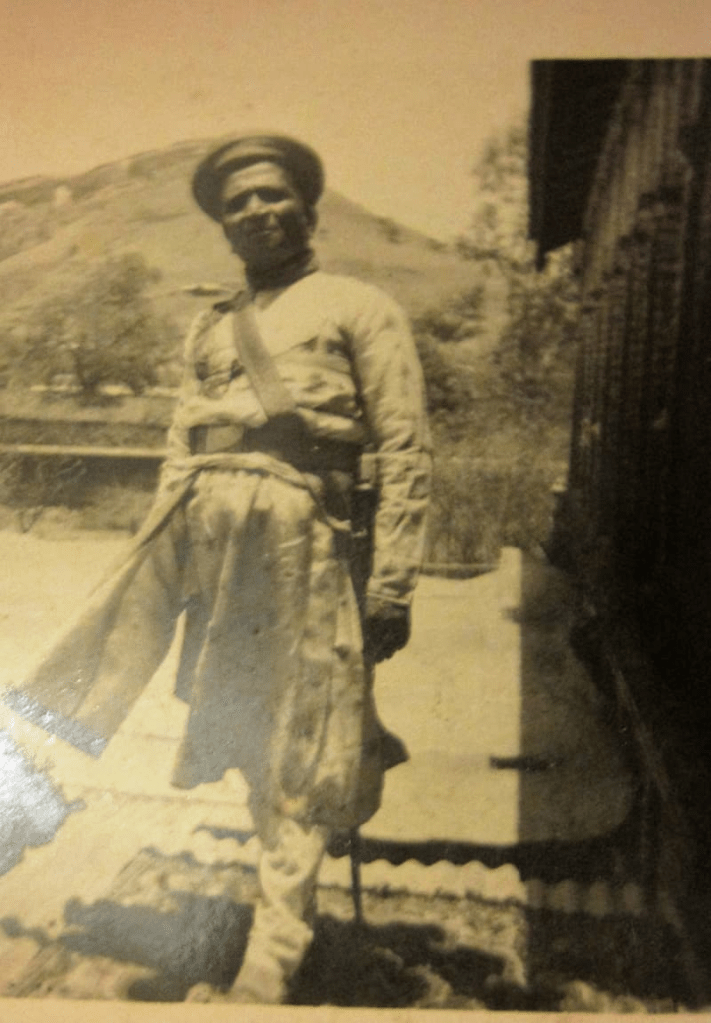
The elder child grown up, in darbar (court) attire. Diwan Mahipatrao Atre.
The old Atre Wada was situated next to the Rajwada of the Pawars of Dewas (Senior) branch in place of the State Court near the Gopal Mandir. After it was possessed by the State for its own affairs, a new Wada was built in Krishnapura by Amrut Bajirao.

Diwan Atre Wada, Dewas. Wada still exists in Krishnapura, Dewas. The Krishnapura area is named after Maharaja Krishnajirao Puar.
Bajirao Amrut was born on 26 January 1875. He was schooled at Daly College Indore and got his Allahabad University degree from the Dewas Victoria High School centre in 1895. He worked as acting Diwan during the beginning of rule of Mharaja Tukojirao III Puar of Dewas. He was also the Honorary Judicial Assistant to the Durbar, Assistant Sessions Judge, Secretary of the Treasury Committee and much more. He enjoyed the fruits of his hereditary post and Jahagirs till January 1913. From then on he started receiving political pension. He passed away in 1945. He had two issue- Mahipatrao alias Appasaheb and Ganpatrao alias Bhausaheb.
After the demise of his father, Mahipatrao started receiving the political pension. Considering his ancestory and contribution to the State, the then Dewas (Senior) State Regent Shrimant Maharani Pramilaraje conferred on him the title of Sardar in 1948. His political pension was converted into a hereditary pension. Sardar Mahipatrao (Diwan in durbar attire) has four sons- Ramchandrarao alias Bhaiyyasaheb, Shrikrishnarao alias Babuji, Madhavrao and Vanmali. Amongst them, the second son has been adopted by the family of the Phadnis of Indore State. His younger brother, Ganpat or Ganesh Bajirao (one with trench watch) had one son, Govind alias Baba Atre.
Today, although reduced in size, the 160 year old Diwan Atre’s Wada still stands strong and functions as a homestay, still owned by the Atre family. The existing wada is of Ganesh Bajirao Atre and his son Govind Atre, the share of Mahipat Bajirao Atre was sold by his sons a long time ago. This wada is now being taken care by the descendants of Govind (Bhausaheb) Atre family. His son Shri Parag Atre now handles the affairs of the estate.
If you are on an expedition to Malwa, like the Puars were in the 17 century and need a place to stay, look nowhere than what once served as a seat of power and comfort to the family of prime ministers. Plan you visit today.


Old mechanisms fade and quartz takes over.
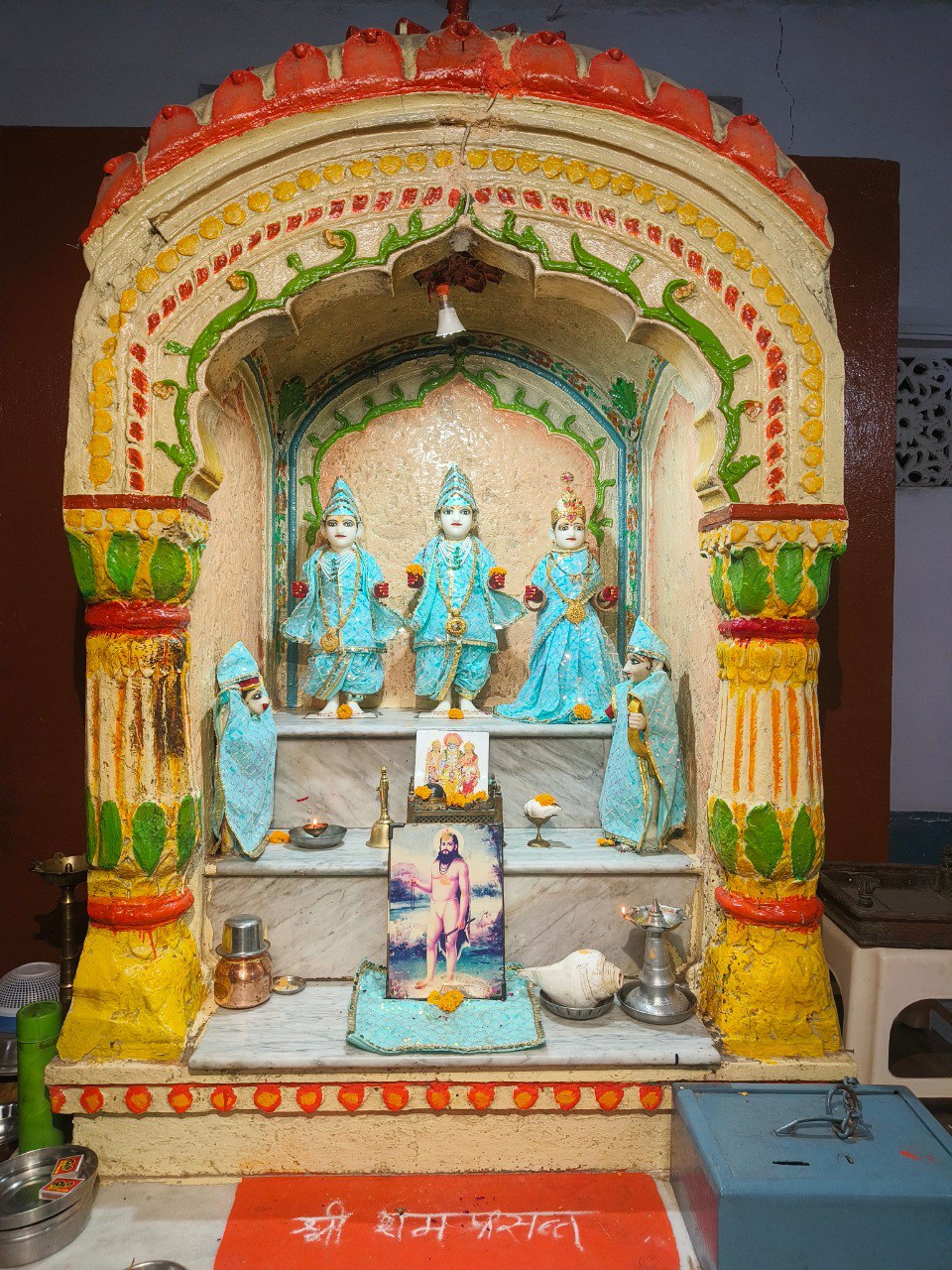
The wada also houses the Atre family’s Shri Gajabai Atre Diwan Shri Ram Mandir in Krishnapura, Dewas.
Like a watch needs a good watchmaker to revive it back, such structures, living legacies often need good architects to restore them. The picture were provided to us by conservation architecture and archiving studio – Studio Gestalt of Pune who have undertaken and still do several conservation architecture projects – reviving old structures as close to as they were in their prime. If you have a project in mind or have a heritage which needs archiving and conservation contact Studio Gestalt at – https://studiogestalt.in/. Yet all credit for the current homestay and continuance of the Atre Wada and its legacy clearly goes to Bhausaheb Atre and family.
The watches discussed here, sadly, have not survived into the present, their disappearance are circumstances of uncertainty. Yet, through the horological record preserved in state archives, we were able to reconstruct their story, contributing another chapter to the rich, venerable, and still largely uncharted history of Indian horology. We remain deeply thankful to Studio Gestalt, Pune, for the trust and responsibility placed in us to tell this story.
We welcome horological heritage in all its forms: historical records, personal archives, and materials connected to the craft of watchmaking. If your collection requires contextual research, verification, and professional archiving, we invite you to get in touch: author@casebackchronicles.com.
 Caseback Chronicles
Leave a comment