
JLC Reverso and the game of Polo
Polo is generally credited for inspiring the creation of the famed Jaeger LeCoultre Reverso. The game, which is now widely played around the world, originated in India. It was popularized in the state of Manipur by then-King Kangba, who gave the game its native name, Sagol Kangjei. Polo is an aberration of the local Meitei name ‘Pulu’, which refers to the wooden ball used in the game.

Marjing – The God of Polo
The god-father of polo is Marjing, the God of the Chenglei tribe, to whom a structure similar to the ancient polo stick along and a ball are still offered in worship. It’s steeped deep into the culture and folklore of Manipur that sequences in festivals are dedicated to the game.
It was 1859, during the First War of Independence, when Lt. Joseph Sherer (known as the Father of Modern Polo) of the British-Indian Army was assigned to Assam. He was introduced to the game by Maharaja of Manipur. Sherer was astounded to discover that the game had been played for thousands of years. Lt. Sherer and his contemporaries later adopted the game, founding the Silchar Polo Club and popularizing it in the West.
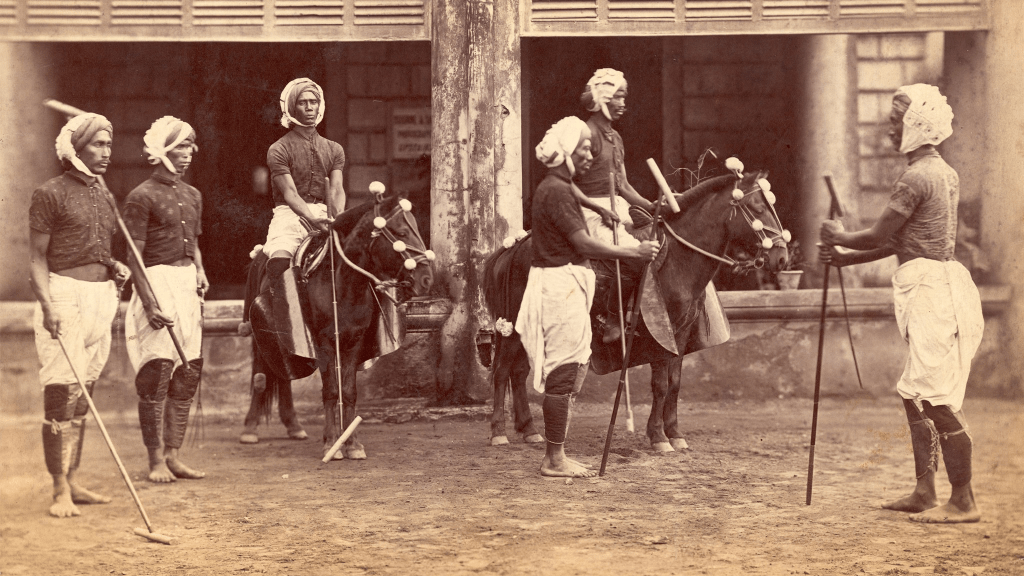
Seven decades later, in the winter of 1930, Swiss businessman and watch dealer-collector César de Trey attended a polo match at a club for British Army officers while traveling in India. One of these players, who had just smashed the crystal of his watch during a game, challenged de Trey to design a watch strong enough to withstand the blows of a polo match.
One of the major issues polo players faced was shattering the glass in their watch during the lengthy and intense matches, which featured a lot of crash and collision because of the players’ repetitive and forceful hand and body movements.
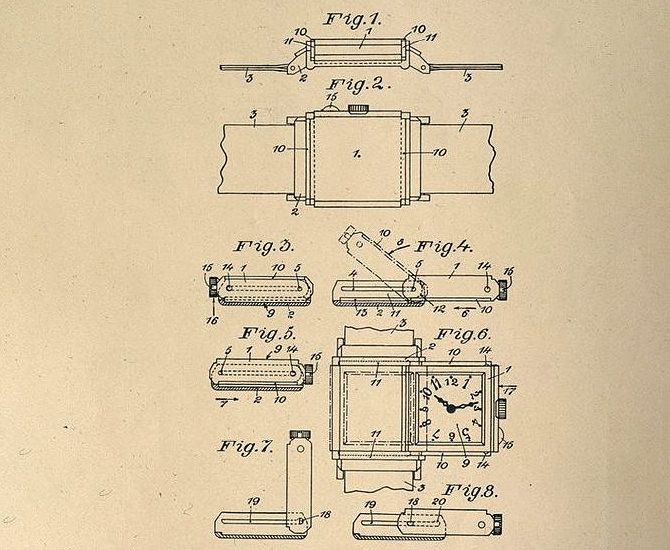
This initiated a series of contacts and collaborations. César de Trey, Jacques-David LeCoultre, then owner of the LeCoultre manufacture, Jaeger S.A. and French industrial designer René-Alfred Chauvot worked closely to make the requested design a reality. Jaeger and LeCoultre had been working in close collaboration since 1903, producing many remarkable references.
The case design is very similar and probably inspired from the Duo Plan which was created in 1925. Within a few months, the patent for a slide and flipping case was filled and granted to the company via the designer.

The Three Enameled Reversos
The bare case back of the reverso provided an open canvas for personalization of the watch. This was during the height of the art deco period, and soon the brand started enamelling and engraving services for its customers. Below are anecdotes of few important pieces which tell a story of love, devotion & service and are deeply embedded in the history of horology and India.
– Please read the note at the end of this article –
Maharaja of Kapurthala – The Reverso of Devotion


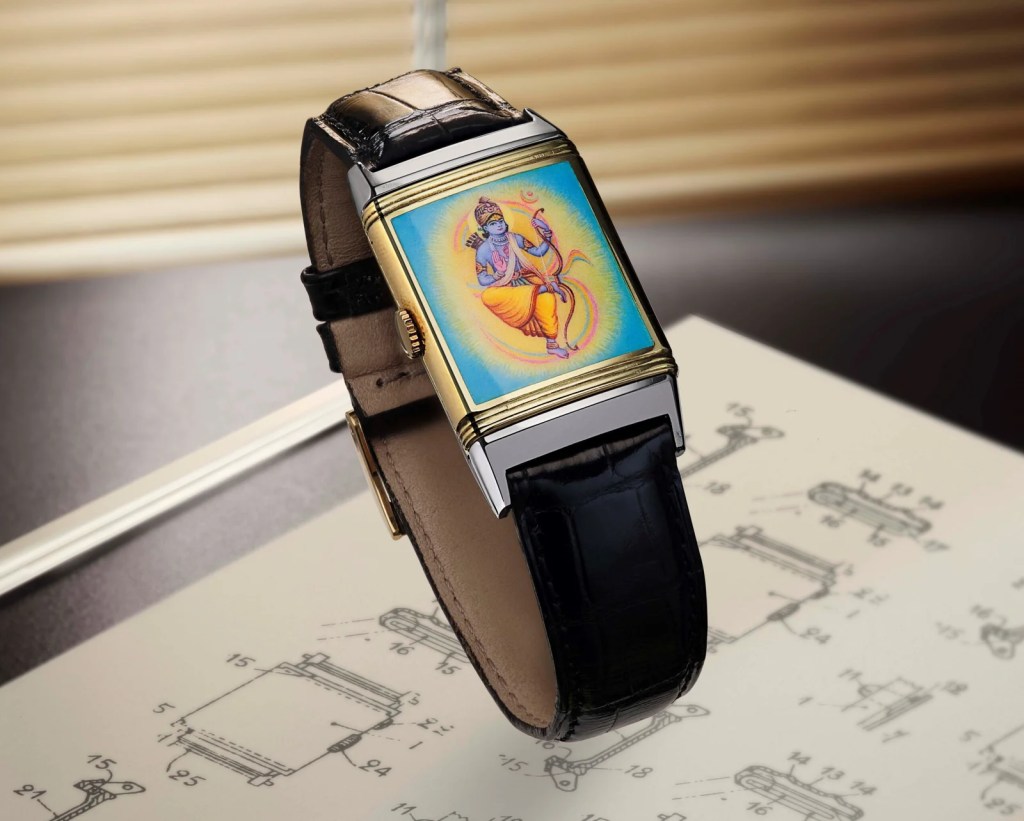
Today – 22 January, 2024 – marks the occasion of prāṇa pratiṣṭhā (consecration) of the Shri Rama temple in Ayodhya. This turns out to be the best watch to tribute the Lord. The JLC Reverso with an enamel of Shri Rama made in a limited edition of 50 for H.H. Sir Jagatjit Singh Sahib Bahadur, Maharaja of Kapurthala in 1932. The watch was made for his close subjects. A story of devotion, from heart to the wrist.

H.H. Sir Jagatjit Singh Sahib Bahadur, Maharaja of Kapurthala
Maharaja of Jaipur – The Reverso of Honour
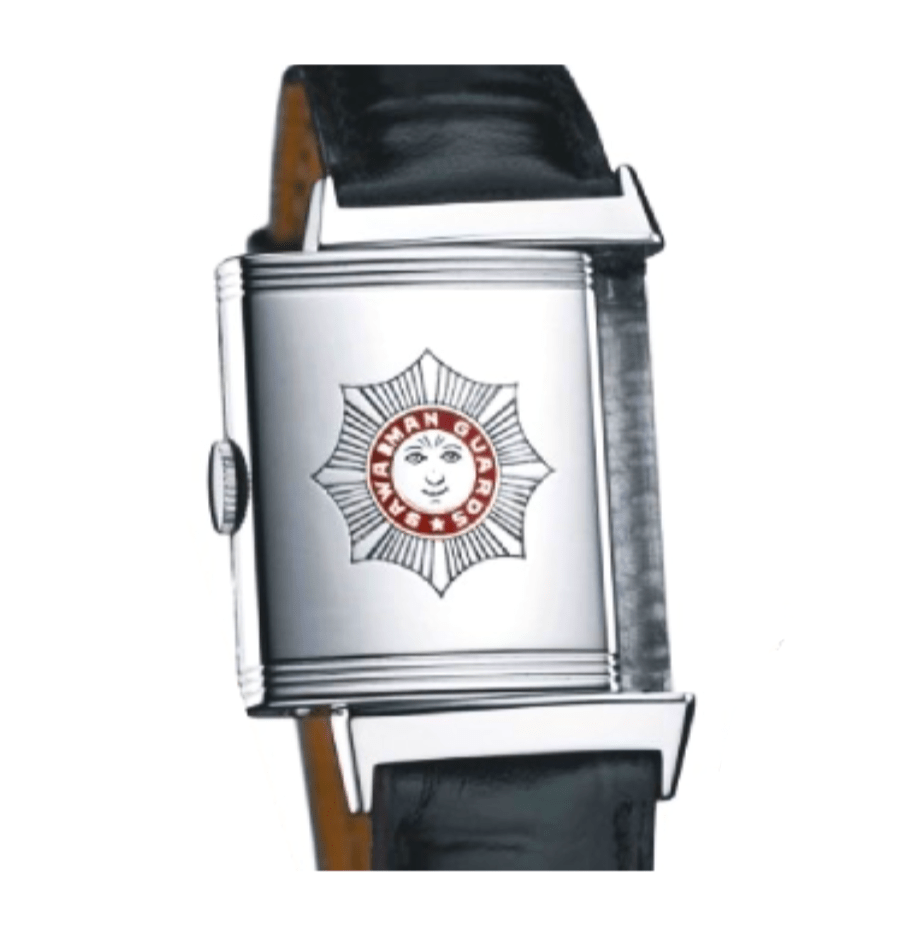
The Sawai Man Guards were the Maharaja of Jaipur’s Body Guards under the Jaipur State Forces of the erstwhile Jaipur State. It was in 1929, when Major General Maharaja Sawai Man Singh II took upon himself to re-raise the Jaipur King Body Guards, similar to the President’s Body Guard of today.
It was an elite unit in the JSF which recruited Rajpoots and was trained in modern warfare methods at the Royal Military Academy (RMA) Woolwich, on the lines of Coldstream Guards, as the Maharaja embarked on a programme of modernization of his state.

Maharaja Sawai Man Singh II inspecting the guards.
The Sawai Man Guards saw major action during World War-II at various places including Europe, Africa and South East Asia whilst embedded with the The Imperial Service Troops and in 1947-1948 war in operations against Pakistan , earning the battle honour of “Ledigali” in Uri Sector of Jammu & Kashmir. The unit was later absorbed in the Indian Army in 1951, now serving as 17th battalion of the Rajputana Rifles.
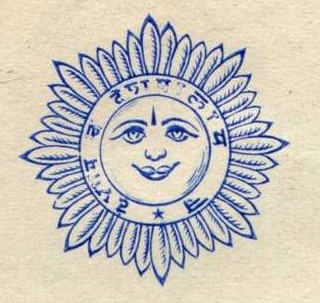
Emblem & Badge of the Sawai Man Guards.
Maharaja Man Singh was himself a noted & established polo player, leading and winning the winning the World Cup in 1933. He would go down in glory doing what he loved most, he passed away following an accident while playing polo in England.
Given his background in polo and himself being an enthusiastic collector. These watches were commissioned by Maharaja Man Singh II of Jaipur in 1935-37 in limited numbers for his favourite officers and bears the emblem of his elite Sawai Man Guards. Such is the honor this watch carries.
Maharaja of Tripura – The Reverso of Love
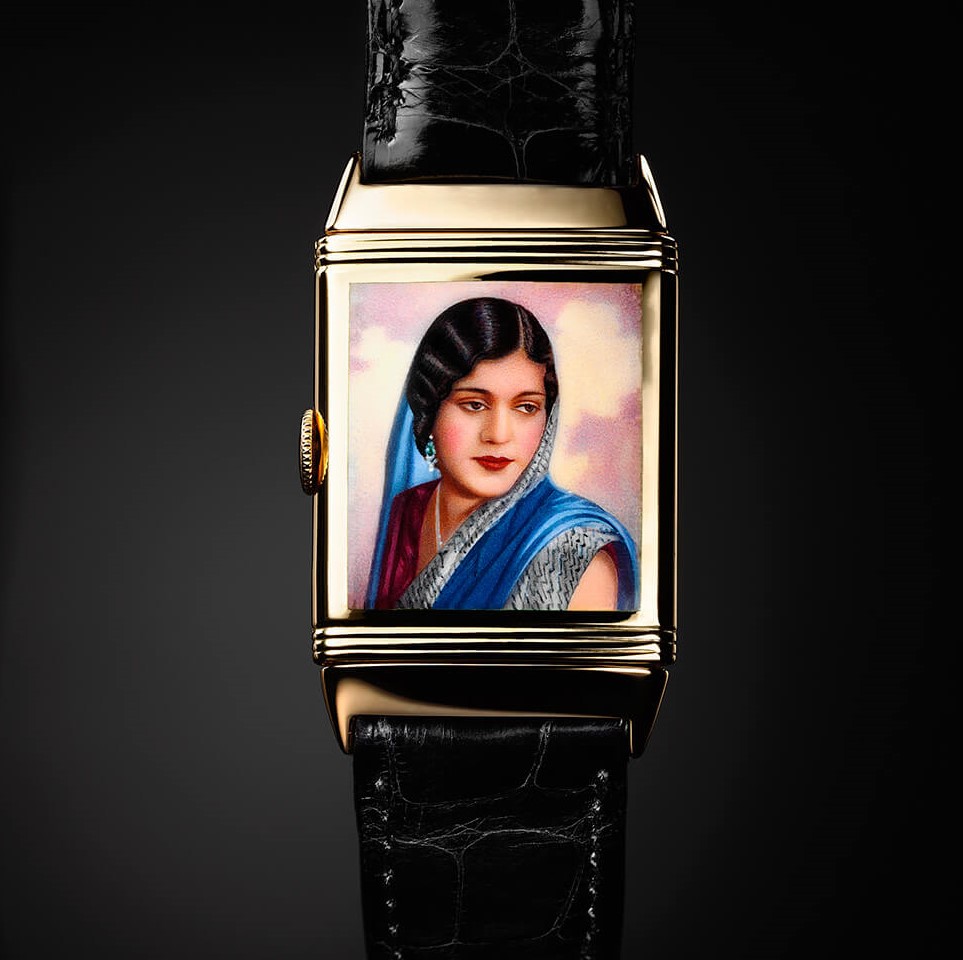
This Reverso has been often dubbed as “The Indian Beauty Reverso”. Indian, because of the distinct clothing style - the saree, the traditional & household women’s garment in India. Thought to be a princess of a royal house or a lady of a merchant family. Who is she?
The portrait, enameled on the case back has been a mystery for almost 80 years, even for the manufacture itself. The piece was purchased in 2004 by Jaeger-LeCoultre at an auction. The watch was bought by a Lufthansa captain in Mumbai, said the auction house, not having any information about it. This compelled JLC to embark on a journey to identify this woman. With no provenance from the previous owner or the auction house.
The only course of action was to sift through archives and pictures of Indian royalties and wealthy merchant families, those were the ones who could think of and afford such an elaborate piece. Surfing through what is called the “Swiss period” – spanning from 1890 to 1960s was when Swiss timepieces flooded the Indian market. With the mentioned people commissioning jewellery and watches.

Back to our watch, this proved difficult even for the JLC archives dept. as there were more than 500+ princely states and many glamorous heirs during the era of art deco charm. Some famous Princesses and queens to narrow down the list were; Princess Gayatri Devi of Jaipur, Princess Sita Devi of Karputhla and Princess Sanyogita Bai Holkar of Indore amongst others known for their elaborate style and affluence, even noted by mags’ like Vogue. But unfortunately none met the innocently charming mystery woman on the watch. This was first noted by the Swiss publication Swiss Info who broke the story for JLC in 2015.
The hunt finally ended in the State of Tripura, a relatively small kingdom on mountains in the eastern corner of India, ruled by 600-year-old Manikya dynasty. The last ruler of Kingdom of Tripura, before merging in the Union of India, was a woman and is interestingly our subject.

Maharani Kanchan Prabha Devi
After the death of Maharaja Bir Bikram Manikya Debbarma Bahadur in 1947, at the ripe age of 38, his 14 year old minor son was crowned king. His mother, Maharani Kanchan Prabha Devi took responsibility of the state and became the last ruler/regent of the State of Tripura, running the state affairs from 1947 to 1949. The Maharaja is popularly known as the “Architect of Tripura” and worked for reserving the land for indigenous people of the land. The legacy and a state of affairs he left for his wife and son.
She took control of a pivotal state during a period of chaos, as the neighboring state of Bengal was communally ripped into two. Tripura faced a significant refugee influx of Hindus fleeing bordering East Bengal and the state risked being involved in the war between India and Pakistan which broke out in 1947. Maharani played a pivotal role during the partition of India in the state of Tripura.

Kingdom of Tripura – written as anglicized ‘Hill Tippera’ on a map from 1900s.
She built up an state force to guard the kingdom from any spillage of the war, rehabilitated the finances of the state & the refugees and victims of partition related violence. She developed the infrastructure legacy of her husband facilitating the essential supply of commodities and direct link to India, all this while tightening the falling government.
After the war was over, she signed the Tripura Merger Agreement on 9th September 1949, merging the state with India in 1949. As the last ruler of Tripura, she did an admirable job in safely steering the state through strenuous time and transition of the state from an independent kingdom to a part of the Indian union.
This was the story of Iron Lady of Tripura, the symbol of Indian feminism. No wonder her husband painted the queen on such an important piece. The watch probably was her husband’s watch, who wanted to keep his queen close to him whenever he went away from the state for work. What a functional and better place to keep a picture than like this. The story of affection, grit & firm governance. Such a lady deserves a piece like this dedicated to her.
Roni Madhvani – The Reverso of Belief
If you happen to travel to Kampala, Uganda, you may find a cool, humble man wearing a jacket ordained with vintage military ensigns with ‘jacket full’ of quirky, unconventional vintage watches, chilling by his pool.
Mr. Madhvani is a collector extraordinaire. A hotelier with a passion & love for unique cases, double-signed & enamelled dials, distinct clocks and pocket watches from the art deco era. A literary man, he has a collection of books and catalogues alongside watches and believes old-fashioned books are great source of knowledge which he often shares this on his ever lively Instagram page – @roni_m_29.

A man connected to his roots, he loves pieces related to Indian history, the Maharajas and other services. Amongst the plethora of unique art deco cases and dials, a piece stands out in his collection, one that connects more than anything.

“The reverso was a gift by my wife when we got married many moons ago, at that time it was a huge thing for me as it was probably the most expensive watch I owned”, remembers Mr. Madhvani.
“A few years later, with the inspiration of the Maharaja Watches at the back of my mind, I requested Le Sentier if they would consider doing an enamel of Hindu saint Jalaram Bapa, whom I believe in. His followers are mainly from Gujarat in western India, from where my grandfather came, crossing oceans to Uganda a century ago”.
Muljibhai Madhvani sailed to Uganda at the age of 14 in 1908 from Aasiyapat in then State of Porbander, the birthplace of Mahatma Gandhi. Setting up a sugar business, expanding it subsequently into an empire, laying foundation of what is today the Madhvani Group.

Jalaram bapa’s fame spread as a divine incarnation. He was born one week after the festival of Diwali, which is associated with his Iṣṭa-devatā Lord Rama. Whoever came to Virpur, irrespective of class, creed or religion were fed and sheltered by Jalaram Bapa at his ashram. This tradition of feeding people continues to this day in Virpur.
The love for art deco – The watch came with a standard dial, not very art deco. Subsequent to receiving the enamel, a few years later the dial was replaced to a more art deco style dial.

“The rendition that was produced, was in fact, not what I had requested, as I was looking for an enamel portrait in the style of the original maharaja ones, but what I received was a combination of enamel and engraving”. This was four decades ago, in the absence of emails, communication took a lot of time.
“Eventually, I gracefully accepted what was done and have come to love it and cherish it passionately” he says, reminiscently.
Note:
A fellow devotee and passionate collector, Mr. Swami Nathan has taken an initiative to Jaeger LeCoultre to make a reissue or a similar watch, as ordered by Maharaja of Kapurthala in 1932 for the occasion of inauguration and consecration of Shri Rama Temple in Ayodhya.
It is planned to be limited run of 50 pieces with a portrait of Shri Rama enameled on the case back. Those strictly interested can contact him @ovmilosz on Instagram and engage in further discussions.
Conclusion
The Indian subcontinent has a rich history and culture. Time and again horological institutions have borrowed elements and individuals commissioned pieces from it. These few show the story of varied emotions of human life that connect from your heart to a beating throb on your wrist.
As I like to say, “Every watch tells a story…”. This proves it.


 Caseback Chronicles
Leave a reply to Sabre Killers – Keelor Brothers, A Tribute. – Caseback Chronicles Cancel reply